
Transform your business
...with virtual assistants
Latest Blog Posts

When an Executive Assistant Can Help a Busy CEO
When your calendar, inbox, and follow-ups keep pulling you away from decisions, an executive assistant for busy CEOs can help restore focus. Executives spend an average of 16 hours per week on manual administrative work. Delegating coordination, communication triage, and meeting preparation can protect more time for leadership priorities.
This support isn’t just for large companies. If you lead a small or mid-sized business and spend too much time keeping work moving, an executive assistant for busy CEOs may be a practical fit. Learn how to spot the signs that it’s time to delegate, which tasks an assistant can take on, and what experience and working habits to look for. The goal is a clearer operating rhythm: fewer avoidable interruptions, stronger follow-through, and more room to lead.
Key Takeaways
- Consider support when calendar demands, message traffic, or missed follow-ups are limiting your time for decisions.
- Delegate meeting coordination and follow-up tracking so decisions, owners, and next steps stay visible.
- Assess candidates for relevant experience, discretion, initiative, and a working style that fits yours.
- Small and mid-sized businesses can use executive assistance to reduce the operational load on leadership.
1. How Do I Know if I Need an Executive Assistant?
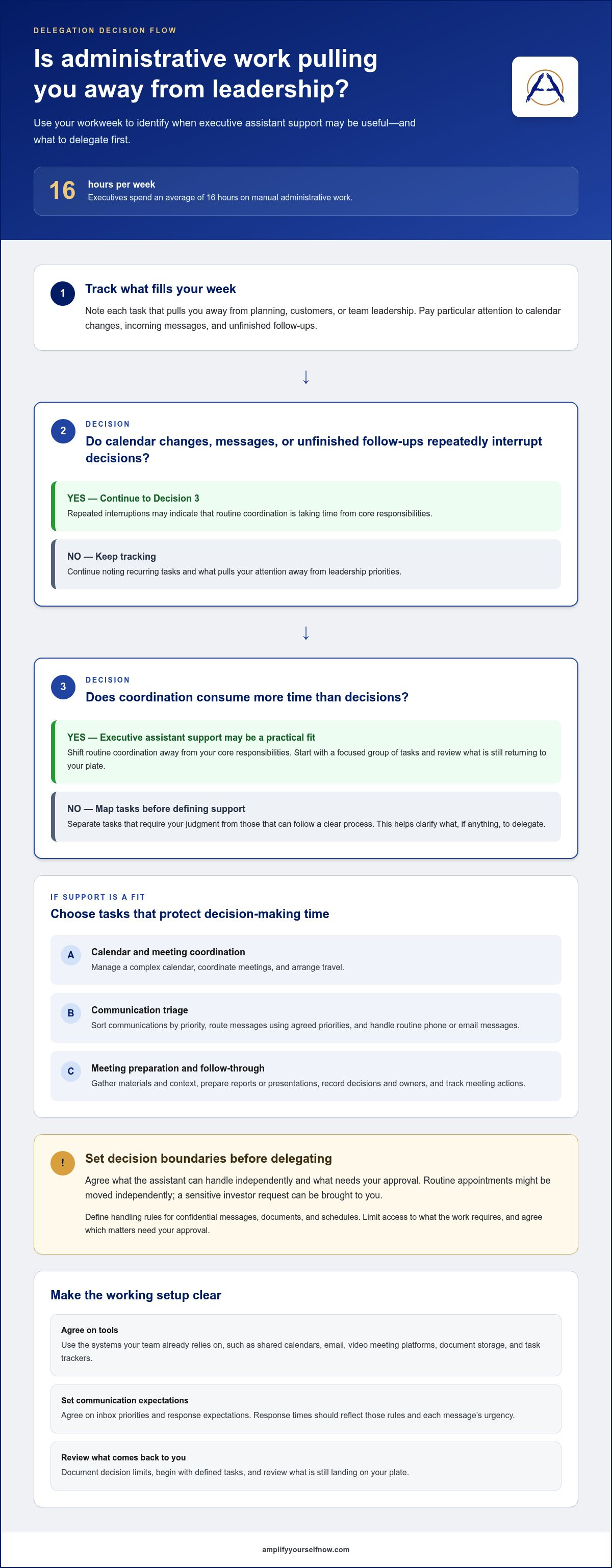
Look at what fills your working day. If calendar changes, incoming messages, and unfinished follow-ups repeatedly interrupt decisions, support may be useful. Executives spend an average of 16 hours a week on manual administrative work. Track your own week and note each task that pulls you away from planning, customers, or team leadership. An executive assistant for busy CEOs can help shift routine coordination away from your core responsibilities.
A CEO’s assistant can manage a complex calendar, coordinate meetings, prepare materials and context, and sort communications by priority. They may handle routine phone and email messages, arrange travel, prepare reports or presentations, and track meeting actions. Before a leadership meeting, for example, an assistant can gather updates and flag open questions. That preparation gives you context for decisions without requiring you to assemble every detail yourself.
Decision-making authority depends on what you delegate. Set clear boundaries: an assistant might move routine appointments independently but bring a sensitive investor request to you. They can also route messages according to your stated priorities. Hiring for this role involves privacy and security considerations because the assistant may handle confidential messages, documents, and schedules. Limit access to what the work requires, define handling rules, and agree on which matters need your approval. An executive assistant for busy CEOs needs clear guidance to act confidently within those limits.
The right tools depend on the work. Executive assistants commonly use shared calendars, email, video meeting platforms, document storage, and task trackers. Agree on the systems your team already uses, then set inbox priorities and response expectations together. Response times should reflect those agreed rules and each message’s urgency.
To assess the need, list recurring tasks, mark which require your judgment, and identify what can follow a clear process. If coordination consumes more time than decisions, support may be a practical next step. A virtual assistant hiring guide can help you define the role and prepare for hiring. Start with a focused group of tasks, document decision limits, and review what is still returning to your plate.
2. Meeting follow-through and task tracking
Effective meeting follow-through starts with a clear record of decisions, owners, and deadlines. After a product review, for example, an assistant can note who will revise the launch plan and when the CEO expects an update. They can enter each commitment in a shared task tracker, then follow up with the owner before the deadline. This keeps decisions from getting buried in meeting notes and gives the CEO a concise view of outstanding work.
Preparation begins before the calendar invitation. An assistant can review the meeting purpose, gather relevant reports, and summarize recent decisions or unresolved questions. For a customer meeting, that might mean assembling account history, open support issues, and the outcome the CEO wants. They can also coordinate attendees, confirm materials, and organize travel details when a trip is required. The CEO arrives with context instead of spending the opening minutes piecing it together.
Board meetings benefit from a structured briefing. An assistant can collect updates from department leads, organize board materials, and flag missing information before distribution. They can prepare a concise agenda, maintain a list of decisions requiring board input, and record action owners afterward. For example, if directors request a revised forecast, the assistant can record who will provide it and track its delivery. This gives the CEO a reliable record between meetings.
Make meeting follow-through repeatable. Before each meeting, agree on its purpose, required preparation, and desired decisions. During the meeting, capture actions in a consistent format. Afterward, send owners their next steps and maintain a tracker the CEO can scan. A graphic designer can help refine presentation visuals, while the assistant coordinates the content and deadlines. Review overdue actions during the next planning session; recurring delays can show where ownership or timing needs clarification.
3. Qualifications and work experience
Choose qualifications according to the work you plan to delegate. Calendar ownership, executive communications, and project coordination call for different strengths. Many executive assistants have college degrees, but a degree isn’t the only route. A candidate without one should be able to show substantial, relevant work experience. Focus on evidence: ask how they have handled competing priorities, protected confidential information, or resolved scheduling conflicts.
Look for responsibility that has grown over time. Previous administrative roles can show whether a candidate has deliberately developed executive support skills. For example, someone who progressed from scheduling appointments to coordinating leadership meetings may be ready for broader ownership. Ask what they managed independently, what required approval, and how they kept leaders informed. Specific examples reveal more than a polished list of duties.
References help you assess those examples. Speak with former employers about reliability, discretion, communication, and follow-through. Ask for an instance when the candidate anticipated a problem or handled pressure without losing track of details. If the role includes personal scheduling or coordination, relevant personal-assistant experience and leadership skills can also help. Match each reference question to a responsibility the new hire will actually own.
Use a structured hiring process. First, write down recurring tasks and decision boundaries. Next, give candidates a realistic scenario, such as resolving a calendar clash between a client meeting and an internal review. Ask them to explain their priorities and what they would escalate. Compare their approach with your management style, communication preferences, and pace. Organizational ability and self-direction matter, but so does fit: the assistant needs to work effectively with the way you lead. In a fast-moving environment, discuss how they manage pressure and deadlines. Look for clear reasoning, careful judgment, and practical systems, not just confidence. A short written exercise can show whether they summarize information accurately and identify next steps. Agree on how the assistant will share updates, flag risks, and handle tasks beyond their authority.
4. Executive assistant support for small and mid-sized businesses
In a small or mid-sized business, a CEO can become the default coordinator for every operational detail. That leaves less time for leadership work, such as setting priorities, guiding managers, and deciding where to focus next. Executive assistance can take on repeatable coordination without requiring the business to build a large administrative team. For example, an assistant can organize the CEO’s calendar, route routine requests, and keep internal follow-ups visible.
Start by identifying the work that repeatedly interrupts leadership. Review a typical week and group tasks by type: scheduling, inbox management, meeting preparation, or coordination across teams. Then define what the assistant can handle independently and what requires CEO approval. A clear boundary might allow routine calendar changes while reserving investor, personnel, or customer escalations for the CEO. This makes delegation useful without creating another approval bottleneck.
Small and mid-sized businesses can begin with outsourced executive assistant support instead of committing to a full-time hire. That approach lets the business delegate a defined set of responsibilities and adjust the scope as workflows change. For instance, a growing company might first hand off scheduling and meeting logistics, then add project follow-up once communication routines are established. Many CEOs notice improvements within the first few weeks when an assistant brings consistency and structure to recurring tasks.
Keep the arrangement organized with a shared task list, written priorities, and regular reviews. Use each review to identify work that still returns to the CEO, clarify decision limits, and update procedures as the team changes. The key measure is whether the support reduces operational drag and protects time for leadership, not whether the assistant stays busy. If you’re ready to define the role around your company’s workload, discuss executive support with Amplify Yourself.
Amplify Yourself: Executive Virtual Assistant
Amplify Yourself, LLC connects business owners with an Executive Virtual Assistant who can take recurring coordination and administrative work off the CEO’s plate. The agency manages sourcing, vetting, and onboarding of remote professionals from the Philippines, presenting at least three pre-vetted candidates within seven business days. This can suit a CEO who has identified clear tasks to delegate, such as calendar coordination, inbox organization, or meeting follow-up, and wants support without adding those duties to another team member’s role.
Before hiring, outline the tasks, decision boundaries, and communication routines that matter most. Amplify Yourself, LLC uses that scope to guide recruitment and match support to your operating needs. If customer inquiries, e-commerce administration, or bookkeeping also need attention, the agency offers those roles as separate support options.
To discuss executive assistant support, visit Amplify Yourself, LLC.
Make Your Next Delegation Deliberate
Choose one recurring responsibility that keeps pulling you away from leadership as a starting point. Define the result you need, the decisions an assistant can make, and what should come back to you. This clear working agreement gives an executive assistant for busy CEOs a practical starting point and lets you assess whether the support is working.
Amplify Yourself, LLC offers Executive Virtual Assistants, along with Customer Support Representatives and E-Commerce VAs for related operational needs. Consider which responsibility would make the most useful difference to your workload, then discuss the role and its scope with the agency.
Contact Amplify Yourself, LLC to discuss your needs and take a clear next step toward a more focused workday.
Frequently Asked Questions
How Do I Know if I Need an Executive Assistant?
You may need an assistant when recurring coordination keeps displacing decisions, customer relationships, or team direction. Notice whether routine work keeps returning to you because ownership is unclear. For example, if you repeatedly pause strategic work to chase an update, identify the handoff that could prevent it. The signal is a persistent pattern of operational drag, not simply one unusually busy week.
What does an executive assistant do for a busy CEO?
An executive assistant helps turn the CEO’s priorities into coordinated action across people and schedules. They can liaise with other senior leaders and their assistants, organize information for decisions, and represent the CEO in selected communications. For instance, they might coordinate a response among department heads before the CEO weighs in. The scope depends on the authority and context the CEO provides.
What skills and qualifications should a CEO's executive assistant have?
Look for sound judgment, initiative, organization, and the ability to learn how the business operates. A capable assistant can distinguish a routine request from one that needs executive attention, then explain the reasoning clearly. Ask candidates how they learn a leader’s priorities and adapt when those priorities shift. Their answers can show whether they think ahead or simply wait for instructions.
How do you find and hire a high-quality executive assistant?
Start with a role scorecard describing outcomes, working relationships, and the decisions the assistant may own. Use it to compare candidates against the actual job, not a generic list of duties. Then assess their examples, references, and approach to work. Amplify Yourself can manage sourcing, vetting, and onboarding for an Executive Virtual Assistant role.
What interview questions should CEOs ask executive assistant candidates?
Ask questions that reveal judgment and communication, not just familiarity with tasks. Try: “Tell me about a time priorities changed suddenly. How did you decide what to handle first?” Follow with, “What information would you need before acting?” and “How would you tell me a deadline was at risk?” Strong answers explain the candidate’s reasoning, communication, and what they learned.
What tasks should a CEO delegate to an executive assistant?
Delegate repeatable work with a clear outcome that doesn’t require the CEO’s unique expertise. Examples include consolidating routine updates into a brief, coordinating information requests across teams, or maintaining a reference library for recurring decisions. Keep sensitive judgment calls and strategy with the CEO unless authority is explicitly delegated. Start with a task that has a defined process and a clear measure of completion.

READY TO GIVE US A TRY?
Get Started for Free Today!
We'll connect you with top overseas talent for all your business endeavors.
Call 925-515-9343
Email: [email protected]


Privacy Policy | ©2026 Amplify Yourself, LLC. All Rights Reserved
Instagram
LinkedIn