
Transform your business
...with virtual assistants
Latest Blog Posts

The Hidden Costs of Hiring a US Employee: A 2026 Executive Guide to True Labor Expenses
Did you know that for every $100,000 you commit to a US salary, your business is actually on the hook for up to $140,000 before a single minute of work is performed? Most founders start the hiring process focused on the sticker price of a salary, only to find their margins eroded by a cascade of taxes, premiums, and administrative overhead. It's easy to underestimate the hidden costs of hiring a US employee, especially as 2026 tax limits and insurance mandates continue to climb. You want to grow your team, but you shouldn't be blindsided by a 40% markup on your payroll that you didn't see coming.
This guide will strip away the complexity and reveal the specific financial drains of domestic hiring, providing you with a clear framework to calculate the true impact on your bottom line. We'll break down the latest 2026 tax rates, health insurance averages, and recruitment expenses that define the current labor landscape. By the end of this article, you'll have the data needed to scale your operations with confidence and decide how to best leverage your resources for maximum growth.
Key Takeaways
- Learn why the base salary typically represents only 60% to 70% of the total financial commitment for a domestic hire.
- Identify the hidden costs of hiring a US employee, including mandatory taxes, insurance premiums, and the administrative friction of legal compliance.
- Calculate the true price of turnover and the productivity gap that occurs during a new hire's ramp-up period.
- Recognize the opportunity cost of founder-led recruitment and how it shifts your focus away from high-level strategy.
- Explore how a managed staffing model allows you to scale your team without the traditional liabilities of domestic employment.
Table of Contents
- The Iceberg of US Employment: Direct vs. Indirect Costs
- The Administrative Tax: Compliance, Payroll, and Legal Friction
- The Financial Damage of Turnover and the 'Bad Hire' Trap
- The Founder's Trap: Why Your Time is the Most Expensive Cost
- Managed Staffing: The Strategic Alternative to Domestic Overhead
The Iceberg of US Employment: Direct vs. Indirect Costs
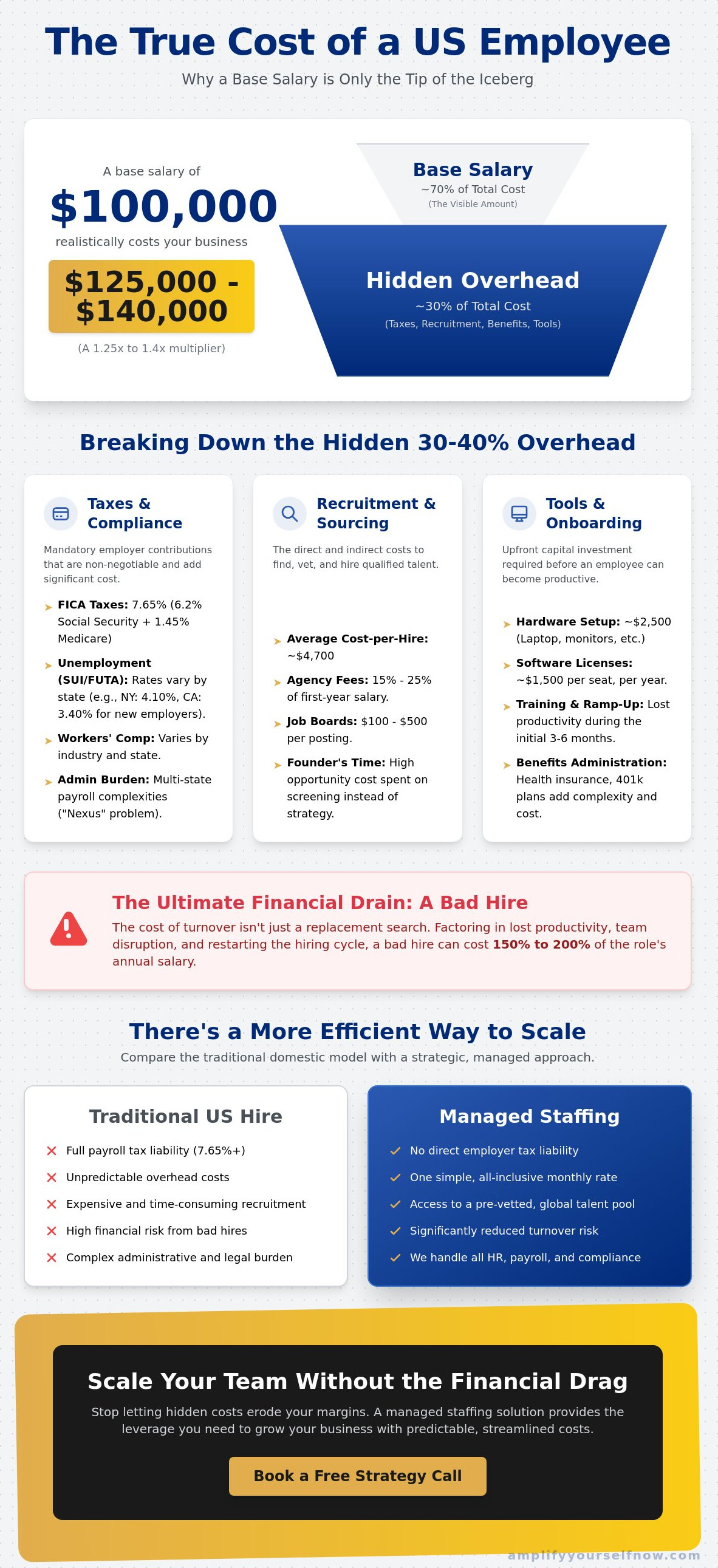
When you look at a candidate's resume, you see a salary expectation. When you look at your profit and loss statement, you see a much larger number. The "True Cost of Hire" is the total investment your business makes before that employee reaches a point of positive ROI. For most scaling businesses, the base salary only accounts for 60% to 70% of the total financial commitment. The remaining 30% to 40% consists of the hidden costs of hiring a US employee that often go overlooked until the first quarterly tax bill arrives.
Experienced operators use a standard multiplier of 1.25x to 1.4x the base salary to estimate the basic "burdened" cost. This means a $100,000 employee actually costs your business between $125,000 and $140,000. For a lean, scaling company, these invisible expenses are particularly punishing because they drain capital that could otherwise be used for lead generation or product development. You aren't just paying for talent; you're paying for the privilege of being an employer in the US system.
To better understand how these expenses accumulate and affect your bottom line, watch this breakdown of hiring costs:
The Multiplier Effect: Why Salaries Are Deceptive
Consider a specialized role, such as a Marketing Assistant, with a base salary of $60,000. On day one, your "burdened" cost already includes employer-paid FICA taxes (7.65%), federal and state unemployment insurance, and workers' compensation. Beyond taxes, the immediate equipment needs are substantial. A professional-grade laptop, dual monitors, and a ergonomic home office stipend can easily add $2,500 to your upfront investment. Software licenses for CRM access, project management tools, and communication platforms often cost another $1,500 per year per seat. These costs hit your cash flow before the employee has completed their first week of training.
Recruitment and Sourcing: The Upfront Capital Drain
Sourcing talent is a major financial hurdle. Industry data shows the average cost-per-hire is approximately $4,700, though this can climb significantly for executive roles. Premium job board placements on LinkedIn or Indeed often cost between $100 and $500 per posting. If you don't have an internal HR team, you're either spending your own high-value time vetting resumes or paying an external agency a fee of 15% to 25% of the first-year salary.
Settling for "low-quality" candidates to save on sourcing fees is a dangerous trap. Poor vetting leads to high costs of employee turnover, which can reach 150% to 200% of the role's annual salary when you factor in lost productivity and the need to restart the recruitment cycle. To avoid these drains on your resources and plan a more efficient growth strategy, you can book a strategy call here to discuss leaner staffing alternatives.
The Administrative Tax: Compliance, Payroll, and Legal Friction
The IRS and state revenue departments are essentially silent partners in your business. They take their cut long before you see a profit. While we've discussed the broad 1.4x multiplier, the granular breakdown of the hidden costs of hiring a US employee reveals a complex web of mandatory contributions that drain your cash flow. Employer-paid taxes are not just a line item; they're a compounding liability. For 2026, you're responsible for a 6.2% Social Security contribution on wages up to $184,500, plus a 1.45% Medicare tax on all earnings. While Federal Unemployment (FUTA) is capped at $42 per employee, state-level unemployment insurance (SUI) can be far more aggressive. In 2026, new employers in New York face a 4.10% rate, while California sits at 3.40%.
Remote work has amplified the "Nexus" problem for scaling companies. If you hire a team member in a different state, you've likely created a tax nexus. This requires you to register for payroll in that jurisdiction, comply with local labor laws, and potentially pay corporate income tax in a state where you don't even have an office. The administrative hours spent managing these filings often outweigh the value of the hire in the early months. If you want to bypass this friction and focus on growth, you might consider how a managed executive assistant can handle your operations without the local tax headache.
State-Level Complexity and Regulatory Compliance
Hiring in states like California or New York adds a significant "compliance premium" to your overhead. These regions have specific mandates for paid family leave, disability insurance, and state-sponsored retirement plans. Maintaining legal compliance for a remote US team means you're constantly chasing moving targets as state legislatures update their requirements. You aren't just paying a salary; you're paying for the specialized bookkeeping and legal oversight required to stay out of court.
Benefits and Insurance: The Non-Negotiable Overhead
Employer-provided benefits now account for approximately 29.7% of the true cost of an employee. In 2026, health insurance premiums continue to climb. Individual coverage averages between $400 and $700 per month, while family plans can range from $1,200 to $2,000. Even policies like "unlimited PTO" carry hidden accounting liabilities that can complicate your year-end financial reporting. When you add Workers' Compensation and General Liability insurance to the mix, the non-negotiable overhead of a domestic hire becomes a major barrier to scaling. To see how you can build a high-performing team without these traditional liabilities, you can schedule a strategy call with us today.
The Financial Damage of Turnover and the 'Bad Hire' Trap
The true value of a hire is only realized when they become a long-term asset to the organization. When a skilled employee leaves, the financial impact is significant. Industry data indicates that replacing a specialized team member often costs between 150% and 200% of their annual salary. For a role earning $80,000, a single turnover event can represent a $120,000 to $160,000 loss when accounting for the recruitment cycle, training, and the vacancy period. These are the hidden costs of hiring a US employee that directly reduce your operational budget without providing any return on investment.
Terminating a domestic employee also involves legal and administrative friction that many operators overlook. Even in at-will employment states, the risk of wrongful termination claims or a significant increase in unemployment insurance rates often leads businesses to offer severance packages as a risk mitigation strategy. This exit cost is a sunk expense that does not contribute to your business objectives. Understanding these risks is essential for maintaining a stable financial forecast as you scale your operations.
Calculating the Productivity Gap
A new hire rarely provides full value immediately. Research suggests it takes approximately 12 weeks for a new employee to reach full productivity. During this window, you are paying a full salary for roughly half the output. This gap is further widened by the time your management team must spend on corrective training and oversight. Every hour spent managing a poor performer is an hour taken away from business development and high-level execution, representing a substantial opportunity cost for the business.
The Hidden Cost of Employee Turnover
Turnover drains more than just cash; it depletes institutional knowledge. When an employee departs, they take specific process insights and client relationships with them, often causing a domino effect where remaining staff become overburdened and disengaged. The total cost of employee turnover is the combined financial weight of recruitment fees, the training ramp-up period, and the loss of operational momentum. To learn more about building a more resilient team structure, you can review our hiring guide for practical delegation frameworks.
The Founder's Trap: Why Your Time is the Most Expensive Cost
As a founder, your time is the most valuable asset in your company. When you spend that time reviewing hundreds of resumes or conducting four rounds of interviews, you're essentially acting as a high-priced recruiter. This is one of the most significant hidden costs of hiring a US employee that never appears on a balance sheet. While you're tied up in the minutiae of HR, your business enters a "strategic vacuum." Growth initiatives stall, product development slows, and high-level partnerships are neglected because the CEO is too busy managing a job posting. You aren't just paying a salary; you're paying with the opportunity cost of your own leadership.
The psychological weight of this process is equally draining. Decision fatigue sets in after the tenth interview, leading to rushed decisions that often result in the "bad hire trap" discussed earlier. You aren't just losing hours; you're losing the mental clarity required to lead your company effectively. "Cheap" local hires often become the most expensive because they require constant supervision to maintain quality standards. If you're spending one full day per week just supervising a single employee, you've essentially increased their cost by 20% of your own salary value.
The Sourcing and Vetting Time Sink
If your time is worth $300 an hour, spending 50 hours on a single hire costs your company $15,000 before the employee even signs an offer letter. This includes the friction of multi-stage interviewing, technical assessments, and reference checking. Vetting candidates is a specialized skill that requires significant focus to get right. To streamline this process and protect your schedule, you can use our hiring guide to implement better vetting frameworks. These systems are designed to filter out low-quality candidates before they ever reach your calendar, ensuring you only talk to the top 1% of talent.
Ongoing Management and Performance Monitoring
Once the hire is made, the administrative burden doesn't end. Domestic staff often expect a high level of "hand-holding" and frequent daily check-ins that disrupt your deep work sessions. There's a fundamental difference between running a business and managing people; many founders find themselves trapped in the latter. This management overhead is a persistent drain on your efficiency. If you're ready to stop acting as an HR manager and start acting as a CEO again, you can schedule a strategy call to discuss how managed staffing can reclaim your time and restore your focus on growth.
Managed Staffing: The Strategic Alternative to Domestic Overhead
Scaling a business requires an operational model that decouples growth from administrative liability. While the traditional domestic model involves the hidden costs of hiring a US employee discussed in previous sections, managed staffing provides a more predictable path for expansion. Amplify Yourself, LLC handles the vetting, payroll, and benefits administration on your behalf. This allows you to integrate an Executive Virtual Assistant into your workflow in as little as seven days, which is significantly faster than the average four-month search for a domestic hire.
Eliminating Administrative Liability
One of the most practical benefits of this model is the consolidation of expenses into a single line item. Instead of managing 15 or more variable costs such as FICA, state unemployment insurance, and workers' compensation premiums, you pay one fixed monthly fee. This structure removes the complexities of tax nexus when hiring across state lines and eliminates the need for domestic insurance overhead. You can view our pricing to see how this simplified approach improves financial forecasting and protects your profit margins.
Focusing on Strategic Growth
By moving away from the role of an HR manager, you can refocus on the activities that directly drive revenue and business value. Managed staffing ensures that your team is pre-vetted and high-performing from day one, reducing the time you spend on corrective training. Whether you need a Lead Generation Specialist to expand your pipeline or support for daily operations, the managed model provides the necessary leverage without the typical management tax. To discuss how to transition your operations to a more efficient model, you can schedule your appointment to scale without the overhead here.
Scale Your Business Without the Administrative Friction
Hiring in the US is a complex financial decision that extends far beyond the base salary. Between the 1.4x multiplier for burdened costs and the administrative friction of multi-state compliance, the hidden costs of hiring a US employee can significantly impact your ability to scale efficiently. Transitioning to a managed model allows you to bypass these hurdles while maintaining a high standard of work and operational consistency.
Amplify Yourself, LLC manages the vetting, payroll, and HR requirements, providing access to qualified talent in as little as seven days. This approach eliminates the tax nexus issues and insurance overhead that typically complicate domestic growth. Building a leaner, more responsive organization is a strategic choice that pays dividends in both capital and time. We're here to help you implement a staffing strategy that supports sustainable growth and long-term stability.
Stop overpaying for overhead—Schedule your strategy call now
Common Questions About US Labor Expenses
What is the average 'burdened' cost of a US employee?
The burdened cost is the sum of an employee's base salary plus all additional employer-paid expenses. These include mandatory taxes like Social Security and Medicare, state unemployment insurance, and workers' compensation. When you add voluntary benefits such as health insurance and 401k matching, the hidden costs of hiring a US employee typically add 30% to 40% to their base pay. For a $100,000 salary, your total outlay is often closer to $140,000.
Are there hidden taxes when hiring a remote employee in a different state?
Yes, hiring across state lines often creates a "tax nexus," requiring your business to register with that state's revenue department. You'll be responsible for withholding state income tax and paying into that specific state's unemployment insurance fund. Additionally, you must comply with local labor laws regarding sick leave and disability insurance, which vary significantly between states. These administrative filings often require specialized bookkeeping support to avoid costly penalties.
How much does it truly cost to replace a high-level manager in 2026?
Replacing a high-level manager in 2026 often costs double their annual salary when accounting for all direct and indirect expenses. This figure includes executive search fees, which can reach 25% of the first-year salary, and the productivity loss during the months the position remains vacant. The "ramp-up" time for a new manager to understand your specific operations adds another layer of financial drain that isn't easily recovered.
What are the legal risks of misclassifying a US worker as a contractor?
Misclassifying a worker as a contractor when they function as an employee can lead to severe penalties from the Department of Labor and the IRS. You may be forced to pay years of back taxes, unpaid overtime, and workers' compensation premiums. Legal fees to defend against misclassification claims often exceed the cost of the original salary. This makes it a high-risk strategy for scaling businesses that need stable, long-term support.
How do I calculate the ROI of my time spent on the hiring process?
To calculate the ROI of your hiring time, multiply your effective hourly rate by the total hours spent sourcing and interviewing candidates. If you spend 40 hours on a hire and your time is worth $250 per hour, that's a $10,000 upfront investment. If the hire fails within six months, your ROI is negative. This calculation highlights why delegating the vetting process is a critical move for operational efficiency.
Can a virtual assistant really handle the work of a US-based executive assistant?
A high-performance Executive Virtual Assistant can handle virtually all tasks traditionally managed by a US-based assistant, including calendar management, travel logistics, and complex project coordination. The primary difference is the delivery model. By using a managed service, you get the same level of strategic support without the hidden costs of hiring a US employee, allowing you to focus purely on results rather than administrative overhead.
What administrative tasks are removed when using a managed staffing service?
Managed staffing services remove the entire "employer of record" burden from your plate. This includes processing payroll, filing state and federal taxes, and managing benefit enrollments. You also bypass the time-consuming process of background checks, skill testing, and initial resume screening. This allows your leadership team to focus on high-impact strategy rather than managing the minutiae of HR compliance and legal filings.
How long does the average US hiring process take compared to offshore staffing?
The domestic hiring process is often slowed by extensive background checks, reference calls, and the standard notice periods required by most US professionals. This timeline frequently extends to 12 weeks or more for specialized roles. Offshore managed staffing bypasses these delays by maintaining a pipeline of pre-vetted talent. This enables your business to fill critical gaps in as little as seven days without sacrificing quality or security.

READY TO GIVE US A TRY?
Get Started for Free Today!
We'll connect you with top overseas talent for all your business endeavors.
Call 925-515-9343
Email: [email protected]


Privacy Policy | ©2025 Amplify Yourself, LLC. All Rights Reserved
Instagram
LinkedIn