
Transform your business
...with virtual assistants
Latest Blog Posts

How to Manage a Virtual Assistant: The Executive Playbook for 2026
Most leaders hire a virtual assistant to buy back their time, but many find themselves spending those reclaimed hours fixing mistakes or clarifying instructions. If you've ever felt the fatigue of micro-management or the frustration of a missed deadline, you aren't alone. Learning how to manage a virtual assistant is often the missing link between a business that simply survives and one that actually scales. You shouldn't have to sacrifice your evening to double-check someone else's work.
This playbook provides a practical system to turn your remote support into a high-performance asset. We'll move past the basic advice of just delegating and look at the actual mechanics of remote leadership. You'll learn how to build a self-sustaining workflow that ensures total clarity on project status and protects your data. By the end, you'll have a clear roadmap to stop supervising tasks and start managing outcomes, giving you the freedom to focus on the high-level strategy your business requires.
Key Takeaways
- Transition from an operator to a strategic architect to eliminate micro-management and focus on high-impact growth.
- Learn how to manage a virtual assistant using a streamlined tech stack that separates urgent communication from project tracking and documentation.
- Implement the 4-step handover method to create a self-sustaining delegation system that maintains high output without your constant oversight.
- Protect your business with secure access tools like LastPass while building a loyal team through an understanding of cultural communication styles.
- Discover how a managed staffing model removes the administrative weight of HR and payroll, allowing you to scale faster.
The Executive Mindset Shift: From Micro-manager to Strategic Architect
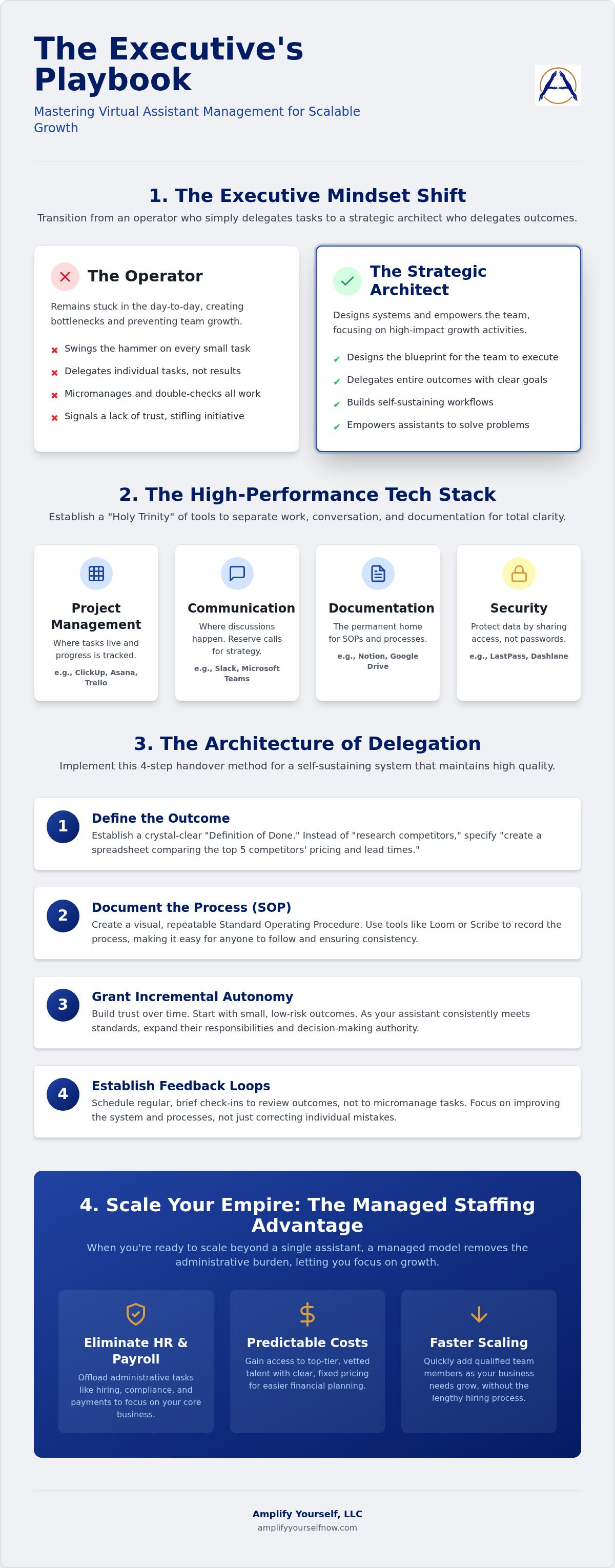
Scaling a business requires a fundamental shift in how you view your team. Most entrepreneurs fail because they remain "operators" who happen to have remote help. They treat their Executive Virtual Assistant like a simple tool rather than a partner. To truly master how to manage a virtual assistant, you must become a strategic architect. An architect doesn't swing the hammer; they design the blueprint that ensures the house stands on its own.
Micro-management is the primary reason for a poor return on investment. When you spend your time hovering over every minor task, you create a bottleneck that slows down operations. This behavior signals a lack of trust and prevents your assistant from developing the initiative needed to solve problems independently. Your goal is to build a system where the process runs without your constant intervention. This starts with a psychological shift where you stop delegating individual tasks and start delegating entire outcomes.
To better understand how to transition from business failures to a successful team structure, watch this video:
Delegating Outcomes, Not Just Tasks
Effective delegation starts with a clear "Definition of Done." Instead of telling an assistant to "research competitors," tell them to "create a comparison spreadsheet of the top five competitors that highlights their pricing and lead times." You're moving from a "do this" mentality to an "own this process" framework. This shift allows your assistant to see the bigger picture and suggest improvements to the workflow. Outcome-based delegation is the practice of defining a successful end state and empowering your assistant to find the most efficient path to reach it.
Setting the Standard of Excellence
Your standards shouldn't be a mystery. Clear communication of your brand voice and quality expectations prevents frustration on both sides. Establish your non-negotiables early. For example, if a 24-hour response time for customer inquiries is a hard rule, document it clearly. Trust isn't granted all at once; it's built through incremental autonomy. Start with small, low-risk outcomes. As your assistant proves they can meet your standards, expand their responsibilities. This approach ensures you maintain quality without becoming a tyrant. It's the only sustainable way to learn how to manage a virtual assistant while reclaiming your own schedule.
Building Your Remote Infrastructure: The 2026 Tech Stack
A high-performing virtual team isn't built on talent alone; it's built on the infrastructure that supports them. If your instructions are scattered across email threads and WhatsApp messages, you'll inevitably face communication breakdowns. Effective infrastructure is the secret to how to manage a virtual assistant without losing your mind to constant pings. You need a "Holy Trinity" of tools that separate work from conversation and documentation, ensuring every team member knows exactly where to find information.
Your stack should consist of a project management tool like ClickUp or Asana, a communication hub like Slack, and a documentation center like Notion or Google Drive. This creates a clear boundary. Tasks live in the project tool. Discussions happen in the communication hub. Permanent processes reside in the documentation center. For security, never share passwords directly. Use a vault like LastPass or Dashlane to grant access to your Executive Virtual Assistant without compromising your sensitive data. This setup is the foundation of a professional, scalable operation.
The Communication Protocol
Distinguishing between asynchronous and synchronous communication is vital for efficiency. Synchronous communication, like Zoom calls, should be reserved for high-stakes strategy or complex problem-solving. Everything else should be asynchronous. This allows your team to work deeply without constant interruptions. Establishing a "24-hour rule" for non-urgent responses ensures progress continues across different time zones without requiring you to be awake at all hours. You can find more structured advice on setting these boundaries in our Hiring Guide.
Visual Documentation and SOPs
Standard Operating Procedures (SOPs) are the lifeblood of a scalable business, but long written manuals are often ignored. Video SOPs created with tools like Loom are more effective because they capture the nuances of a task in real-time. Aim to create a "Single Source of Truth" where every process is recorded and easily searchable. A practical tip for knowing how to manage a virtual assistant effectively is to have them build this library for you. Once you demonstrate a task once via video, have your assistant transcribe it into a written step-by-step guide. This turns your daily operations into a permanent asset that lives beyond any single hire. If you're ready to stop being the bottleneck and start building a self-sustaining team, you might consider scheduling a strategy call to discuss your specific scaling needs.
The Architecture of Delegation: SOPs and Feedback Loops
Delegation is not a single event; it is a process. Many entrepreneurs struggle because they treat delegation like dumping a task and hoping for the best. To understand how to manage a virtual assistant effectively, you must build a structure that ensures consistency and quality. This requires a repeatable framework for handing over work and a consistent cadence for checking in on progress.
The 4-Step Handover Method
The goal of this method is to move from your direct involvement to a high-quality, independent output. It prevents the "broken telephone" effect where instructions are lost in translation. By following these steps, you ensure your assistant understands your expectations perfectly.
- Step 1: I Do. Record yourself performing the task. Use screen recording software to capture every click and decision point. This becomes the raw material for your SOP.
- Step 2: We Do. Your assistant watches the video and writes the step-by-step documentation. Then, they perform the task while you observe or review their work. This ensures they understand the "why" behind the "what."
- Step 3: You Do. The assistant takes full ownership. They execute the task independently using the SOP they created.
- Step 4: I Audit. You step back from daily execution but maintain a periodic quality control check. This keeps the standard high without requiring your constant presence.
Establishing the Management Cadence
Consistent communication prevents small misunderstandings from becoming expensive mistakes. A "Daily Stand-up" or End of Day (EOD) report is the simplest way to maintain alignment. This report should be brief, covering what was completed, what is planned for tomorrow, and any bottlenecks preventing progress. It provides total clarity on project status without needing a 30-minute meeting every morning.
For higher-level support, such as an Executive Virtual Assistant, you should also schedule monthly strategy sessions. These meetings aren't for task updates. They are for aligning on long-term goals and reviewing performance data. When giving feedback, focus on the process rather than the person. Use specific examples from your audits to show where the output missed the mark and how to correct it. This data-driven approach empowers your assistant to improve and eventually manage the process entirely on your behalf. If you're ready to implement these systems with a vetted professional, you can book a call to discuss your scaling goals.
Performance, Security, and Cultural Nuance
Building a high-performance remote team requires more than just a set of tools and a project board. It demands a deep understanding of the environment your assistant operates in. If you want to master how to manage a virtual assistant for the long term, you must address the human element and the technical security risks simultaneously. Success in 2026 is defined by how well you bridge the gap between your expectations and your assistant's cultural reality.
Leading Philippines-Based Teams
The Philippines remains the gold standard for offshore executive support due to high English proficiency and a service-oriented culture. However, many entrepreneurs struggle with the "Hiya" concept. This is a cultural trait rooted in a sense of shame or embarrassment, which can sometimes lead an assistant to say "yes" even if they are confused or overwhelmed. To lead effectively, you must actively dismantle the traditional hierarchy. Encourage proactivity by rewarding questions and creating a safe space for feedback. When your assistant feels comfortable pointing out a potential bottleneck, they stop being a task-doer and start being a partner. For a deeper look at these dynamics, see our guide on Virtual Assistant Philippines support.
Measurement is the only way to ensure consistent growth. Instead of tracking hours worked, focus on three specific Key Performance Indicators (KPIs):
- Accuracy: The percentage of tasks completed correctly on the first attempt without needing revisions.
- Speed: The ability to meet or exceed established deadlines consistently.
- Proactivity: How often the assistant identifies a problem and presents a solution before you have to ask.
Security and Trust Protocols
Trust is earned, but security must be engineered. You should never share your master passwords or sensitive credentials directly through chat or email. Use password management tools like LastPass or Dashlane to grant access to specific accounts without revealing the actual password. For sensitive work like Data Entry or financial management, require the use of a secure workstation and a verified VPN. This creates a professional boundary that protects your business while giving your assistant the autonomy they need to work efficiently.
At Amplify Yourself, we handle the ongoing performance monitoring and HR support so you don't have to. Our managed model ensures that your assistant stays aligned with your goals while we manage the administrative and cultural nuances in the background. If you are ready to secure your operations with a vetted, high-performing professional, schedule your strategy session today.
Scale Your Empire: The Managed Staffing Advantage
Scaling a business involves a paradox: the more you delegate, the more people you have to manage. For many CEOs, the time saved by hiring help is quickly consumed by administrative overhead like payroll, performance reviews, and vetting. Learning how to manage a virtual assistant effectively means recognizing when you should stop being the direct manager and start utilizing a managed staffing model. This shift allows you to focus on high-impact strategy while a dedicated partner handles the operational details.
The hidden costs of solo management are often overlooked until they disrupt your workflow. When you hire a freelance assistant, you are responsible for everything from tracking their hours to managing their professional development. If that assistant leaves, the cost of turnover is high, often requiring you to spend another 30 to 40 hours finding a replacement. A managed service eliminates this cycle by providing a stable infrastructure and a deep bench of vetted talent. You aren't just hiring a person; you're hiring a system.
Managed vs. Unmanaged VAs
Hiring a freelancer often puts you in the role of an HR director. You must verify skills, check references, and navigate international payment laws yourself. In contrast, a managed agency like Amplify Yourself provides a managed experience that reduces your management burden. We provide ongoing HR support, which means you don't have to be the one handling performance issues or cultural misalignments. By using a structured system, you ensure that your Executive Virtual Assistant remains a high-performance asset. You can review our pricing for managed services to understand the investment required for this level of professional support.
Your Next Step to Absolute Leverage
Speed is a competitive advantage. Our 7-day placement promise means you can go from an overwhelmed schedule to having a vetted professional in place in just one week. This rapid onboarding allows you to stop working in your business and start working on it almost immediately. The ROI of a professionally managed assistant isn't just measured in hours saved. It's measured in the mental clarity you gain when you no longer have to worry about the logistics of how to manage a virtual assistant on your own. You are building a system designed for scale, not just a temporary fix for a busy week.
This is the path to absolute leverage. When you have a loyal, high-performing remote team supported by a management layer, your business can grow without your constant supervision. You deserve the freedom to focus on the vision that started your business in the first place. To begin this transformation and see how our Philippines-based talent can support your growth, schedule your strategy call to amplify your business.
Building Your Scalable Future
Mastering the art of remote leadership is the single most effective way to reclaim your time and focus on high-impact strategy. By shifting your mindset from a micro-managing operator to a strategic architect, you create a business that functions independently of your daily presence. We've explored the essential tech stack, the 4-step handover method, and the cultural nuances of leading Philippines-based talent. These systems ensure that knowing how to manage a virtual assistant becomes a core competency of your executive leadership rather than a source of daily stress.
The transition to a high-performance team doesn't have to be a slow or burdensome process. With Amplify Yourself, you can access vetted talent in as little as seven days while we handle the ongoing HR and performance support for you. This managed staffing model removes the operational friction, allowing you to scale with confidence. If you're ready to stop supervising tasks and start driving growth, scale your business today with an Executive VA. Your focus belongs on the vision; let us help you build the team that makes it a reality.
Frequently Asked Questions
How do I track my virtual assistant's hours and productivity?
Use a time-tracking tool like Time Doctor or Hubstaff to record active hours and provide screen captures for verification. However, true productivity is measured by task completion in your project management software. If you use a managed staffing model, the agency often handles high-level performance monitoring for you. This allows you to focus on results rather than counting minutes. Clear deadlines and daily end-of-day reports are the most effective ways to verify consistent progress.
What is the best way to handle communication across different time zones?
Asynchronous communication is the standard for managing global teams. Use tools like Slack for messaging and Loom for video instructions to eliminate the need for real-time presence. Establish a "24-hour rule" for non-urgent responses to ensure work continues while you sleep. If you require specific overlap hours for live collaboration, define those clearly during the onboarding process. This structure prevents burnout and keeps projects moving forward without the need for constant late-night meetings.
How do I securely share passwords and sensitive data with my VA?
Never share raw passwords through email or chat. Instead, use a secure password manager like LastPass or Dashlane to grant access without revealing your actual credentials. For sensitive tasks like lead generation or bookkeeping, require your assistant to use a verified VPN and a secure workstation. These protocols protect your business data while giving your assistant the autonomy they need. Establishing these security standards early is a critical part of learning how to manage a virtual assistant safely.
What should I do if my virtual assistant makes a mistake?
Address mistakes immediately by reviewing the relevant Standard Operating Procedure (SOP). Determine if the error was a result of unclear instructions or a process failure. Use the "I Do, We Do, You Do" method to retrain the assistant on that specific task. If you use a managed service, you can also involve their HR support to address recurring performance issues. This data-driven approach focuses on improving the system rather than assigning blame, which builds a more resilient team.
How often should I have meetings with my remote assistant?
Minimize live meetings to maximize deep work time. A weekly 15 to 30-minute sync is usually sufficient to align on priorities and resolve bottlenecks. Supplement this with daily end-of-day reports submitted via Slack or your project management tool. Monthly strategy sessions are better suited for reviewing long-term goals and performance data. This cadence ensures you stay informed on project status without becoming a bottleneck yourself or wasting time on unnecessary calls.
Can a virtual assistant manage my email and calendar effectively?
Yes, an Executive Virtual Assistant can act as a gatekeeper for your time. Start by creating a "Communication Playbook" that defines which emails they should handle, which to archive, and which to escalate to you. For calendar management, provide clear rules for booking meetings, including your preferred time blocks and buffer zones. Once they understand your logic, they can manage your schedule with total autonomy, allowing you to focus on high-impact strategy instead of daily logistics.
What are the most important KPIs to track for a virtual assistant?
Focus on three primary Key Performance Indicators: accuracy, speed, and proactivity. Accuracy measures the percentage of tasks completed correctly without needing revisions. Speed tracks the ability to meet deadlines consistently. Proactivity is the most valuable metric for high-level assistants, as it measures how often they identify and solve problems before you have to intervene. Tracking these metrics provides a clear picture of your assistant's ROI and helps you identify areas where they can take on more responsibility.
How do I ensure my offshore VA understands my brand voice?
Create a comprehensive Brand Style Guide that includes your tone of voice, preferred vocabulary, and examples of past successful content. Have your assistant review your existing emails or social posts to internalize your communication style. When they produce new work, provide specific feedback on where they hit or missed the mark. Over time, this iterative process helps them replicate your voice with high precision. This is a vital skill when learning how to manage a virtual assistant for marketing or customer support roles.

READY TO GIVE US A TRY?
Get Started for Free Today!
We'll connect you with top overseas talent for all your business endeavors.
Call 925-515-9343
Email: [email protected]


Privacy Policy | ©2025 Amplify Yourself, LLC. All Rights Reserved
Instagram
LinkedIn