
Transform your business
...with virtual assistants
Latest Blog Posts

VA for Architects: Scaling Your Firm Through Strategic Delegation
The biggest threat to your firm’s growth isn't a lack of clients; it's the hours you lose to administrative friction. Many principals find that as their firm grows, their actual design time shrinks, replaced by permit tracking, scheduling, and invoicing. This shift isn't just a nuisance; it's an operational bottleneck that prevents you from taking on higher-value projects. Integrating a specialized va for architects into your workflow offers a practical solution to this problem. It allows you to delegate the non-billable tasks that currently consume your day, ensuring your focus remains on project delivery rather than paperwork.
You likely already recognize that your current administrative burden is unsustainable if you want to scale your operations. This article provides a clear roadmap for using strategic delegation to professionalize your firm's systems. We'll examine the specific tasks a virtual assistant can handle, from zoning research to vendor coordination, and how to integrate them into your existing design workflow. By the end of this guide, you'll understand how to leverage offshore talent to increase your billable hours and streamline your project management without the overhead of a local hire.
Key Takeaways
- Identify the administrative bottlenecks that cannibalize design time and learn why delegating these tasks is essential for firm growth.
- Discover how a specialized va for architects can manage complex permit tracking and vendor coordination to keep your projects on schedule.
- Leverage the economic advantages of the Philippine talent pool to secure high-tier executive support while significantly reducing overhead.
- Establish a seamless remote workflow by centralizing project documentation and setting clear communication protocols for your design team.
- Explore how a managed recruitment model can place a vetted, high-performing assistant in your firm in as little as seven days.
The Billable Hour Trap: Why Architecture Firms Struggle to Scale
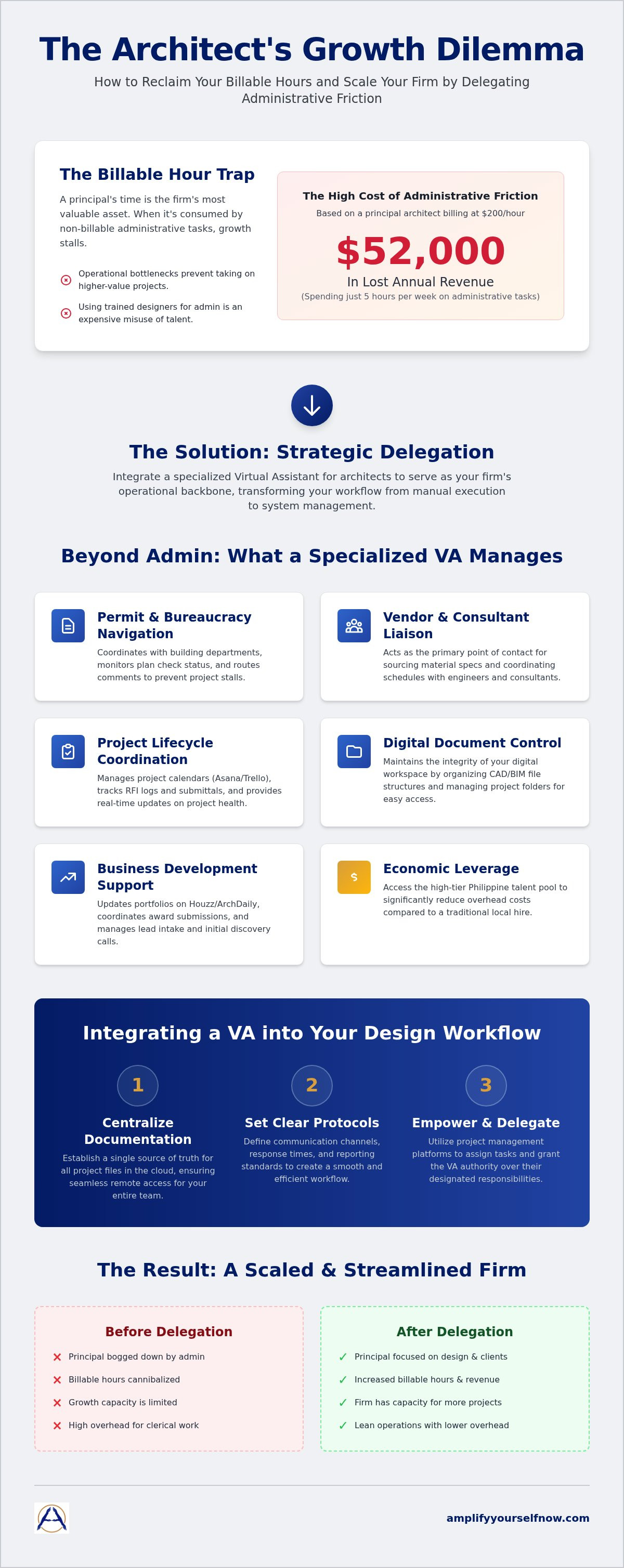
The billable hour trap is a common obstacle for growing architecture firms. It occurs when a principal's time is consumed by low-value administrative tasks instead of revenue-generating design work. While it's tempting to handle these tasks yourself to save on immediate costs, the long-term impact on your firm's profitability is negative. When you spend your time on permit tracking or scheduling, you're effectively paying a principal’s rate for clerical work. A specialized va for architects serves as the operational backbone of your firm, ensuring these tasks are handled efficiently without distracting from high-level project management.
The High Cost of Administrative Friction
Administrative friction doesn't just slow you down; it costs you money. If a principal architect bills $200 per hour but spends five hours a week on invoicing and zoning research, the firm loses $1,000 in weekly revenue. Over a year, that's $52,000 in lost billable time. Delegating these tasks to junior architects is also a poor strategy. Using a trained designer for purely administrative functions is an expensive misuse of talent that often leads to employee dissatisfaction. Poorly managed systems lead to missed deadlines and delayed permit approvals, which can damage your reputation with clients and contractors alike.
Shifting from Practitioner to Firm Owner
Scaling requires a shift in how you view your role. You aren't just a designer; you're a business owner. This requires moving away from manual execution and toward system management. Hiring a virtual employee is a practical first step in this transition. In an architectural context, a Virtual assistant (occupation) functions as a Project Coordinator. Integrating a va for architects into your team ensures that the flow of documentation and permit follow-ups happens on schedule. This allows you to maintain a lean operation while increasing your firm's capacity. If you're ready to professionalize your workflow, you can schedule a strategy session at book now to see how we can place a vetted assistant in your firm within seven days.
Beyond Admin: Specialized Tasks for an Architecture VA
A va for architects does more than manage an inbox. They handle the industry-specific logistics that keep a project moving from schematic design through construction administration. One of the most time-consuming phases is permit tracking. A specialized assistant coordinates directly with building departments, monitors plan check status, and ensures that comments are routed to the right team members immediately. This prevents the "black hole" effect where projects stall because a permit application is sitting on a desk waiting for a minor clarification. You stay focused on the design while they navigate the bureaucracy.
Beyond city hall, they act as the primary liaison for vendors and consultants. Whether it's sourcing material technical specs or coordinating schedules with structural engineers, your assistant ensures the information flow never stops. They also maintain the integrity of your digital workspace. By organizing CAD and BIM file structures and managing project folders, they ensure every team member can find the latest revisions without digging through messy directories. This level of document control is vital for maintaining professional standards and reducing errors during the design development phase.
Project Lifecycle Coordination
Execution requires constant monitoring. Your assistant manages the project calendar, setting milestones in platforms like Trello or Asana to keep the team accountable. They track RFI (Request for Information) logs and submittals for contractors, ensuring that site questions are answered within the required window. When consultant feedback or site visit reports come in, the VA updates the project timeline. This gives you an accurate, real-time view of the project's health without requiring you to manually check every detail.
Business Development and Portfolio Management
Growth requires visibility. An assistant keeps your firm’s portfolio updated on Houzz and ArchDaily, ensuring your best work is seen by potential clients. They coordinate with a marketing specialist for award submissions and social media content. By managing lead intake and initial discovery calls, they filter prospects. This ensures you only spend your time on high-value opportunities that fit your firm's expertise.
Financial and Document Control
The financial side of architecture is complex. A VA handles bookkeeping tasks such as AIA billing and expense tracking. They keep technical specifications and contract documents organized for quick retrieval during audits or site meetings. They also stay ahead of administrative deadlines like insurance renewals and professional membership fees. Exploring these specialized workflows is the first step toward reclaiming your time. You can learn more about finding the right fit for your team at Amplify Yourself. If you are ready to delegate these tasks, schedule a call today.
The Economic Leverage of Philippine Virtual Assistants
The Philippines has established itself as the premier destination for architecture firm support, offering a unique combination of technical skill and cultural alignment. For a US-based firm, the advantage goes beyond simple cost reduction. It is about accessing a talent pool that possesses high English proficiency and a deep understanding of Western business standards. Most Filipino professionals are trained in communication styles that mirror those used in the US; they are accustomed to the fast-paced, results-oriented nature of architectural project management. This makes a va for architects from this region particularly effective at managing client expectations and coordinating with local building departments without the communication friction often associated with other offshore locations.
Cost Comparison: Offshore VA vs. Local Staff
Hiring offshore provides clear economic leverage when you analyze the total cost of employment. A local US-based administrative hire requires a salary, health benefits, payroll taxes, and physical office space. When you factor in these overhead costs, the price of local talent often doubles their base pay. In contrast, a Philippine-based assistant offers significant savings while delivering a high level of professional output. Verified industry data suggests that firms can achieve operational cost savings of up to 60% by shifting administrative and project coordination roles to a remote model.
Using a managed virtual assistant service further optimizes these savings by removing the burden of recruitment and HR management from your plate. This model allows you to scale your team based on your current project load. You don't have to worry about the long-term liability of a full-time local employee during a slow period. You gain the flexibility to expand your capacity exactly when a new project breaks ground, ensuring your overhead remains lean and your firm stays profitable.
Vetting for Technical Competence
High-quality output depends entirely on the caliber of your talent. Generalist virtual assistants often struggle with the specialized terminology and complex workflows required in an architecture firm. This is why a multi-stage vetting process is essential for technical roles. We test for technical aptitude, project management proficiency, and communication clarity. Hiring a dedicated executive virtual assistant to serve as a va for architects ensures you have a partner who understands how to manage RFI logs and coordinate with structural engineers.
Amplify Yourself manages this entire process, vetting candidates for technical and cultural fit so you can focus on design. We provide ongoing HR support to ensure the relationship remains productive and professional. If you're ready to see how this leverage can transform your firm’s profitability, you can book a strategy session at book now. Our managed staffing model is designed to place a vetted assistant within seven days, allowing you to start scaling your firm immediately.
Integrating a VA into Your Design Workflow
Integrating a va for architects into your firm is not just about hiring a person; it's about installing a system. Successful delegation depends on clear communication protocols that prevent information silos. Instead of relying on fragmented emails, establish a dedicated channel in Slack or Microsoft Teams. This centralizes project-related chatter and keeps your inbox clear for high-level client negotiations. Pair this with a cloud-based documentation system like Dropbox or Google Drive. When every drawing, permit, and spec is stored in a structured, shared environment, your assistant can find what they need without interrupting your design flow.
Consistency comes from a predictable rhythm. Set up brief daily or weekly sync meetings to align on project goals. These shouldn't be hour-long marathons. A 15-minute "stand-up" is often enough to identify blockers and confirm priorities for the day. This structure ensures that your assistant is always working on the most impactful tasks, moving projects forward while you stay focused on the creative vision. Establishing these boundaries early allows the relationship to move from basic task execution to high-level project coordination.
Essential Tools for Remote Architecture Support
Visual project tracking is vital in architecture. Tools like Trello or Monday.com allow your assistant to track a project through every phase, from schematic design to construction administration. You can see the status of every permit or RFI at a glance. For accurate client billing, implement time-tracking software. This provides the data needed for transparent invoicing without manual logging. Additionally, use Loom for quick video walkthroughs. It's much faster to record a two-minute video explaining a design change than it is to write a long email. These tools bridge the gap between your office and your remote team, ensuring absolute clarity.
Building SOPs for Seamless Delegation
Delegation only works when you have documented Standard Operating Procedures (SOPs). Start by creating a step-by-step guide for your permit submission workflow. Detail exactly which forms are needed and who the primary contacts are at the local building department. You should also develop templates for client onboarding and project kickoff communications. This ensures a professional, consistent experience for every new lead. Finally, document a clear process for archiving project files once a build is complete. These SOPs turn your firm into a repeatable machine rather than a series of one-off tasks. If you are ready to build these systems and scale your firm, schedule a strategy call with Amplify Yourself to find an assistant who can manage these workflows for you.
Scaling Your Firm with Amplify Yourself
Building an architecture firm requires precision, and your hiring process should be no different. Many firm owners attempt the DIY route by posting on general job boards, only to find themselves sifting through hundreds of unqualified resumes. This "self-service" approach often consumes dozens of hours that would be better spent on design or high-level project management. Amplify Yourself, LLC eliminates this friction through a managed recruitment model specifically designed for architecture firms. We handle the heavy lifting, providing a va for architects who is already vetted for technical and cultural fit. Our model reduces the risk of a bad hire by ensuring every candidate has been pre-screened for the specific demands of a design-build environment.
Our Proven Recruitment Process
We don't believe in generalist solutions. Our process begins with custom sourcing based on your firm’s specific software requirements and project management workflows. Whether you need an assistant who understands BIM coordination or someone to manage complex AIA billing, we find candidates with the exact skill set you require. Our multi-stage vetting process tests for high-level communication and problem-solving abilities. We filter through the noise to present only the top 1% of candidates for your final interview. This targeted approach ensures that you don't waste time talking to anyone who isn't a perfect match for your firm’s culture and operational needs.
Onboarding for Long-Term Success
Integration is where many remote partnerships fail, but our managed model is built for long-term success. We don't just place an assistant and disappear. We facilitate the initial training and integration to ensure your new va for architects understands your firm's specific Standard Operating Procedures. Our performance managers provide ongoing monitoring and HR support, acting as a bridge between you and your assistant. This managed staffing model reduces your management burden, allowing you to scale your operations without the typical headaches of remote hiring. Our 7-day placement timeline means you can move from an initial consultation to a fully integrated assistant in just one week. If you're ready to stop sifting through resumes and start delegating effectively, schedule your strategy call to find your architecture VA today.
Establishing a Scalable Foundation for Your Firm
Scaling an architecture firm is a matter of operational efficiency. By delegating the administrative tasks that currently create bottlenecks, you can focus on the high-level project management and design work that drives revenue. We have discussed how the billable hour trap limits your growth and how a specialized assistant can manage the logistical complexities of permit tracking and consultant coordination. This approach isn't about working harder; it's about using leverage to work smarter.
Hiring a va for architects through a managed model provides a reliable way to professionalize your firm. Amplify Yourself offers a 7-day placement guarantee, providing only the top 1% of vetted candidates. Our service includes managed HR and performance monitoring to ensure your assistant remains a productive part of your team. If you are ready to streamline your operations and increase your firm's capacity, Book Your Strategy Call to Scale Your Firm. Taking this step will allow you to focus on the work that matters most while your systems run efficiently in the background.
Frequently Asked Questions
What technical skills should I look for in a VA for architects?
Look for proficiency in project management tools like Trello or Asana and a strong grasp of architectural terminology. A va for architects needs the technical aptitude to manage RFI logs, submittal schedules, and permit tracking. While they don't need to be designers, they must understand the lifecycle of a project to coordinate effectively with consultants. This industry-specific knowledge reduces your training time and ensures they can handle complex coordination tasks independently.
How does a virtual assistant handle site visits or physical permit filings?
While they cannot be physically present, they manage the logistics of these tasks remotely. They coordinate with local couriers for physical document delivery and track the status of permit filings through online portals or phone follow-ups. For site visits, they can organize your field notes and photos into professional reports. They function as a central communication hub, ensuring that data from the physical world is documented in your digital systems.
Can a VA from the Philippines work during US business hours?
Most professional assistants in the Philippines work on schedules that align with US business hours. This graveyard shift in their local time allows them to be available for real-time communication via Slack or Microsoft Teams during your workday. You won't have to wait overnight for a response. This synchronization is vital for fast-paced design environments where project deadlines and consultant feedback require immediate attention and coordination.
What is the typical cost of hiring an architecture VA through an agency?
Hiring through a managed agency involves a one-time recruitment fee for sourcing and vetting, followed by a monthly staffing fee. This recurring cost covers the assistant's salary and benefits along with ongoing HR management and performance monitoring. While specific rates depend on the technical complexity of the role, this model is significantly more cost-effective than local hiring. It removes the hidden costs of payroll taxes, office space, and employee benefits from your firm's overhead.
Do I need to provide software licenses for my virtual assistant?
You typically provide access to the software your firm already uses. This ensures your assistant is fully integrated into your existing workflows and security protocols. Whether it's a seat on your project management software or access to your cloud-based file system, providing these licenses allows for seamless collaboration. It's the most efficient way to ensure your remote team member has the exact tools they need to manage your project documentation and schedules.
How do I ensure my firm’s data and client designs remain secure?
Data security is managed through professional vetting and secure digital protocols. You should use encrypted password management tools and grant tiered access to your cloud storage systems. Hiring through a managed agency provides an extra layer of protection, as candidates are vetted for reliability and cultural fit. We also provide guidance on setting up secure remote workflows that protect your intellectual property while allowing your assistant to remain productive.
What is the difference between a general VA and an Executive Virtual Assistant for architects?
A general assistant focuses on basic administrative tasks like data entry or simple scheduling. An Executive Virtual Assistant (EVA) for architects is a high-level partner who understands the nuances of the design industry. They manage complex project coordination, track permit statuses, and act as a liaison for consultants. The EVA takes ownership of operational outcomes, allowing you to delegate entire processes rather than just individual, minor tasks.
How long does it take to see a return on investment after hiring a VA?
Return on investment is often immediate once you redirect your recovered hours toward billable design work. Most owners see a shift in productivity within the first month. By delegating non-billable friction to a va for architects, you can take on more projects without increasing your personal workload. If you're ready to scale, you can schedule a call at book now to find your assistant in seven days.

READY TO GIVE US A TRY?
Get Started for Free Today!
We'll connect you with top overseas talent for all your business endeavors.
Call 925-515-9343
Email: [email protected]

Privacy Policy | ©2025 Amplify Yourself, LLC. All Rights Reserved
Instagram
LinkedIn