
Transform your business
...with virtual assistants
Latest Blog Posts

Strategic Benefits of a Virtual Bookkeeper in 2026: The Executive Guide to Financial Leverage
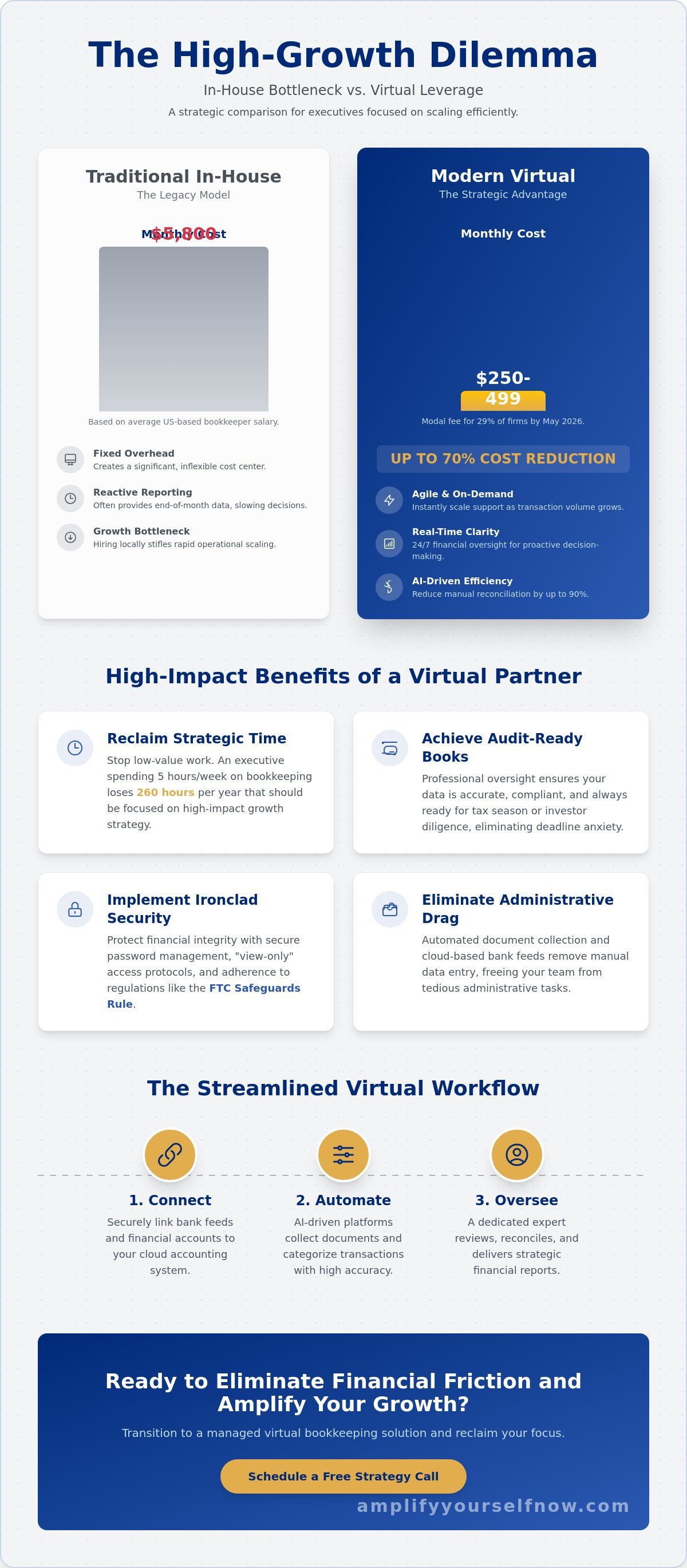
Your time as an executive is worth more than the $5,800 monthly salary of an in-house bookkeeper. For high-growth firms, the decision to hire locally often creates a bottleneck that stifles scale and drains overhead. Understanding the benefits of a virtual bookkeeper is no longer about simple cost-cutting; it's about strategic decoupling. By May 2026, the modal monthly fee for virtual bookkeeping has stabilized between $250 and $499 for 29% of firms. This shift allows you to offload the administrative drag of transaction categorization and bank reconciliations to experts who operate with 90% more efficiency through AI-driven automation.
At Amplify Yourself, LLC, we recognize the pressure of the FTC Safeguards Rule and the constant anxiety of tax season deadlines. It's frustrating to lack real-time visibility into your cash flow while paying a premium for local talent. This guide will show you how to leverage a vetted virtual partner to achieve audit-ready books and reclaim your time for high-impact strategy. We'll examine the 2026 pricing landscape, essential security protocols, and how to integrate these services to amplify your operations. If you're ready to eliminate financial friction now, you can schedule a strategy call to begin the transition.
Key Takeaways
- Transition from traditional desk-bound accounting to agile, cloud-based oversight to maintain real-time financial clarity.
- Leverage the benefits of a virtual bookkeeper to reduce operational overhead by up to 70% while ensuring your financial systems scale alongside your growth.
- Implement automated document collection and cloud-based bank feeds to eliminate manual data entry and administrative drag.
- Protect your financial integrity by using "view-only" access protocols and secure password management tools for all remote collaborations.
- Execute a streamlined transition plan to match with an elite bookkeeper who acts as a strategic partner in your business expansion.
What is a Virtual Bookkeeper and Why Does Your Business Need One Now?
Elite entrepreneurs understand that growth is a game of subtraction, not addition. To scale, you must remove yourself from low-value cycles. A virtual bookkeeper is a remote professional who manages your general ledger, reconciliations, and financial reporting via cloud-based systems. They aren't just data entry clerks; they are the architects of your financial clarity. While software like QuickBooks Online records data, a dedicated professional ensures that data is accurate, audit-ready, and strategically useful. In 2026, the "Virtual First" back office is the standard for high-performers who refuse to be slowed down by local hiring constraints or physical paperwork.
One of the primary benefits of a virtual bookkeeper is the shift from reactive to proactive management. Traditional accounting often relies on end-of-month "catch-up" sessions that leave you looking at the past. A virtual partner provides agile, 24/7 financial oversight, allowing you to make decisions based on what's happening in your business today. By May 2026, automation platforms have reached a point where they can reduce manual reconciliation by 90%, but you still need an expert to oversee the logic and ensure compliance with regulations like the FTC Safeguards Rule.
To better understand how this role functions in a modern business, watch this breakdown:
The Evolution of Remote Financial Management
Cloud technology has made physical proximity to receipts obsolete. High-performers are abandoning the DIY approach because they recognize that real-time data is a competitive advantage. Modern Bookkeeping involves syncing bank feeds and using OCR technology to capture expenses the moment they happen. This evolution means you no longer wait for a quarterly report to see your margins. You see them now. You amplify your decision-making speed because your ledger is a living document, not a stagnant record.
Identifying the 'Time-Theft' in Your Current Process
Stop doing $25 per hour work if your goal is a seven-figure legacy. When an executive handles transaction categorization, they're engaging in expensive time-theft. If you spend five hours a week on financial hygiene, you're losing 260 hours a year that should be spent on high-impact strategy. Signs that you've outgrown your current system include anxiety over tax deadlines and a lack of cash flow visibility. Offloading these tasks provides immediate psychological relief. It clears the mental fog and allows you to focus on your highest potential. If you're ready to reclaim your time, you can schedule a strategy call to find the right leverage for your business.
5 High-Impact Benefits of a Virtual Bookkeeper for Growing Empires
Scaling a business requires a ruthless commitment to leverage. You can't lead an elite organization while tethered to a ledger. The primary benefits of a virtual bookkeeper involve more than just organizing receipts; they provide the structural integrity your business needs to withstand rapid growth. By May 2026, the distinction between "doing the work" and "managing the system" has become the defining line between stagnating entrepreneurs and visionary CEOs. You need a system that operates at the speed of your ambition.
- Massive Cost Reduction: Save up to 70% compared to the $5,800 monthly commitment of a full-time, US-based hire. This capital can be reinvested into your core marketing or product development.
- Unmatched Scalability: Your bookkeeping should grow with you. A virtual model allows you to increase support hours immediately as your transaction volume or new entities expand.
- Professional Accuracy: Stop relying on "entrepreneurial intuition" for tax categorization. Professional oversight ensures every dollar is accounted for according to current ASU 2023-08 standards for crypto or traditional assets.
- Strategic Clarity: Clean monthly P&L statements are not just for your CPA. They are the diagnostic tools you need to identify leaks and double down on profitable channels.
- Audit-Readiness: Keep your business "sale-ready" or "loan-ready" at all times. A clean set of books is the ultimate sign of a mature, professional operation.
Drastic Overhead Reduction Without Quality Loss
Local hires carry hidden costs that drain your momentum. Between payroll taxes, health benefits, and physical office space, a domestic bookkeeper's true cost is often 30% higher than their base salary. One of the most immediate benefits of a virtual bookkeeper is the ability to access elite offshore talent. Professionals in the Philippines provide a cost-effective solution that maintains a high standard of professional mastery. These experts often possess CPA-level training and are well-versed in global accounting standards. The ROI of virtual bookkeeping is the ratio of hours reclaimed to dollars spent.
Real-Time Reporting for Better Decision Making
Stop guessing your burn rate and start weaponizing your data. Moving from monthly "catch-up" sessions to weekly reconciliations gives you the agility to pivot in real-time. When you know your exact cash position, you can make aggressive moves for business expansion without the fear of overextending. High-performers use financial data to identify trends before they become problems. If you're ready to see how this level of clarity changes your daily operations, you can explore our pricing options to find the right fit for your current stage of growth.
The Virtual Bookkeeping Workflow: How It Works in Practice
Understanding the benefits of a virtual bookkeeper requires a shift from viewing bookkeeping as a monthly chore to seeing it as a continuous, automated engine. The process begins with deep cloud integration. By syncing your bank feeds directly with cloud-based accounting software such as QuickBooks Online or Xero, your bookkeeper creates a real-time data stream. This setup eliminates the need for manual data entry and ensures that your financial records are always current.
Automation is the heartbeat of a modern workflow. Elite bookkeepers utilize tools like Hubdoc or Dext to automate receipt capture. You simply snap a photo or forward an email, and the software extracts the data. For ecommerce businesses, these automation platforms can reduce manual reconciliation by 90%, allowing your bookkeeper to focus on high-level analysis rather than chasing paper. A managed agency approach further ensures zero downtime; if one professional is unavailable, a supervisor steps in to maintain the rhythm. This consistency is vital for maintaining the 24/7 financial oversight expected in 2026.
Standardizing Your Financial Engine
Your business needs a Chart of Accounts tailored specifically to your industry to provide meaningful insights. A virtual bookkeeper establishes this foundation and sets up automated rules to handle approximately 80% of recurring transactions. Beyond simple ledger management, they take over the heavy lifting of Accounts Payable and Receivable. This ensures your vendors are paid on time and your invoices are collected without you having to send a single reminder email. This ensures your financial reporting aligns with the latest standards, such as the 2026 GAAP Financial Reporting Taxonomy accepted by the SEC on March 17, 2026.
Seamless Integration with Your Existing Team
A virtual bookkeeper acts as the bridge between your daily operations and your tax professional. By maintaining clean books throughout the year, they significantly reduce the billable hours your CPA spends on clean-up during tax season. This financial clarity is amplified when paired with an Executive Virtual Assistant, who can handle the administrative side of document flow while the bookkeeper focuses on the numbers. The boundaries are clear. The bookkeeper prepares the data and flags anomalies, but you retain final approval on all major transfers and strategic shifts. If you're ready to install this engine in your business, you can book an appointment to discuss your specific needs.
Addressing the #1 Concern: Security and Data Integrity
Security is the primary barrier for executives considering remote financial support. However, the benefits of a virtual bookkeeper are only realized when built on a foundation of absolute trust and technical rigor. In 2026, data protection is not optional. The FTC Safeguards Rule, updated in June 2023, classifies bookkeeping services as financial institutions. This means your virtual partner must adhere to strict encryption and multi-factor authentication standards. You don't need to hand over the keys to your business; you simply need to grant the right level of visibility.
A professional workflow utilizes the "View-Only" protocol. This allows your bookkeeper to categorize transactions and reconcile accounts without ever having the authority to move funds or initiate transfers. By using password management tools like LastPass or 1Password, you share credentials securely without the bookkeeper ever seeing the actual characters of your password. This layered approach ensures that your capital remains under your exclusive control while the data management is delegated to an expert. It's a calculated move that prioritizes both security and operational speed.
Building a Fort Knox Financial Workflow
Implementing Two-Factor Authentication (2FA) across all financial portals is your first line of defense. Modern accounting software also provides a comprehensive "Audit Trail" feature. This tool records every change made to the ledger, including who made it and when. This transparency makes it nearly impossible for errors or unauthorized changes to go unnoticed. Many high-performers choose the Philippines for their remote staff because the culture prioritizes professional ethics and compliance. The best agencies in this region often hold a SOC 2 Type II compliance report, which proves their security controls have been effective for at least six months.
Trust but Verify: The Managed Staffing Model
Hiring a random freelancer on a marketplace is a significant risk that can jeopardize your financial hygiene. A managed agency model provides a layer of accountability that individual contractors cannot match. At Amplify Yourself, LLC, we vet candidates for both technical mastery and integrity through a rigorous Hiring Guide protocol. This includes background checks and skill assessments specifically designed for financial roles. Ongoing performance monitoring ensures that security standards never slip as your business scales. If you want to secure your back office with elite talent, you can book a strategy session to review our vetting standards in detail.
Amplify Your Results: Transitioning to a Managed Virtual Bookkeeper
Transitioning to a remote financial model shouldn't be a months-long project that drains your energy. The 7-Day Sprint is our answer to the slow, traditional hiring process. Most executives spend upwards of 40 hours reviewing resumes and conducting interviews for a local role that could be filled more effectively by offshore talent. We've optimized this process to match you with an elite professional within one week. This speed allows you to maintain your momentum while immediately offloading the administrative weight that holds you back.
One of the most significant benefits of a virtual bookkeeper through a managed agency is the total elimination of HR friction. When you hire a freelancer from a marketplace, you become their manager, their IT support, and their payroll department. The difference at Amplify Yourself, LLC is that we handle the performance monitoring and technical training. You get the results without the management overhead. Your bookkeeper becomes a strategic growth partner who provides the data you need to scale. They don't just record what happened; they help you see what's possible for your business's future.
Custom Sourcing for Your Specific Industry
Industry-specific experience is the difference between a generic ledger and a strategic asset. A real estate investment firm has vastly different reporting requirements than a high-volume ecommerce brand or a medical practice. Our multi-stage vetting process is designed to find the top 1% of talent in the Philippines. We look for professionals who already understand your specific niche, so you don't have to spend weeks teaching them the basics. This level of specialization ensures that your financial reporting is accurate from day one. For a comprehensive look at how to build this type of remote team, explore our guide on Virtual Assistant Philippines: The 2026 Executive Guide to Strategic Outsourcing.
Ready to Amplify Your Business?
Stop being the bottleneck in your own accounting department. If you're still the one chasing receipts or approving every minor reconciliation, you're capping your company's potential. The logic is clear: you must delegate the friction to accelerate the growth. Reclaiming ten hours a week from bookkeeping tasks gives you over 500 hours a year to focus on legacy-building and high-impact strategy. It's time to move beyond mediocrity and embrace the highest potential of your business. You have the vision; now you need the engine to support it. Schedule your strategy call and find your virtual bookkeeper now to take the next step in your expansion.
Take Control of Your Financial Trajectory
Your ability to scale depends on how effectively you delegate low-leverage tasks. The benefits of a virtual bookkeeper center on providing the clarity and time required to focus on high-impact strategy. By offloading your general ledger and monthly reconciliations to a professional, you eliminate the administrative drag that stalls momentum. You gain a partner who ensures your books are audit-ready and compliant with the latest 2026 financial standards without the burden of domestic overhead.
Amplify Yourself Now provides a turnkey solution that bypasses the risks of unvetted marketplaces. We match you with elite talent possessing specialized expertise in QuickBooks and Xero in as little as 7 days. Our managed approach includes ongoing performance monitoring and HR support, so you don't have to manage the manager. It's a strategic move designed for the modern operator who values speed and precision. Scale your business with a vetted Virtual Bookkeeper today and start building your legacy with a back office that supports your ambition. You've built the vision; now it's time to install the engine that drives it forward.
Frequently Asked Questions
What is the difference between a virtual bookkeeper and a CPA?
A virtual bookkeeper manages your daily financial health by recording transactions, reconciling bank statements, and maintaining an accurate general ledger. Their role is to ensure your data is clean and current. A CPA, or Certified Public Accountant, uses the reports generated by your bookkeeper to handle high-level tax strategy, audits, and official government filings. Think of the bookkeeper as the specialist who maintains the engine, while the CPA is the navigator who plans the long-term route.
Is it safe to give a virtual bookkeeper access to my bank accounts?
It is safe when you utilize "view-only" access levels provided by modern financial institutions. This specific permission allows your bookkeeper to download statements and categorize transactions without having the authority to move funds or change account settings. By combining this with multi-factor authentication and secure password managers, you maintain absolute control over your capital while delegating the data management. This layered security approach is a standard protocol for elite remote teams in 2026.
How many hours a month does a virtual bookkeeper typically work for a small business?
Most small businesses require between 5 and 10 hours of work per week to maintain clean records. For businesses with annual revenue between $500,000 and $2 million, this often scales to a more comprehensive monthly retainer. Data from April 2026 shows that 29% of bookkeeping firms now price their services in the $250 to $499 monthly bracket for core services. This allows you to pay only for the level of support your current transaction volume requires.
What software do I need to have to work with a virtual bookkeeper?
You need cloud-based accounting software such as QuickBooks Online, Xero, or Zoho Books to facilitate remote collaboration. These platforms allow for real-time syncing of bank feeds and provide a centralized location for your financial data. Most virtual bookkeepers also utilize document capture tools like Dext or Hubdoc. These tools allow you to forward receipts via email or a mobile app, which the bookkeeper then reconciles against your bank statements.
Can a virtual bookkeeper help me with my business taxes?
They prepare your business to be "tax-ready" but do not typically file the returns themselves. One of the primary benefits of a virtual bookkeeper is the elimination of the year-end "scramble" for receipts. By keeping your books audit-ready every month, they significantly reduce the billable hours your CPA spends on tax preparation. If you want to see how this transition simplifies your year-end, you can book a strategy session to review our workflow.
What happens if my virtual bookkeeper makes a mistake on my ledger?
Errors are identified during the monthly reconciliation process where ledger entries are matched against third-party bank statements. Modern software also maintains a digital "Audit Trail" that records every change made to the books, including the user and the timestamp. A managed agency model provides an additional layer of safety by including a supervisory review. This ensures that discrepancies are caught and corrected before they impact your financial reporting or tax filings.
How do I communicate with my bookkeeper if they are in a different time zone?
Communication is handled through asynchronous tools like Slack, email, or dedicated project management portals. Many professional bookkeepers in the Philippines align their working hours to provide a 3 to 4 hour overlap with US business days. This allows for real-time meetings when necessary while the bulk of the work is completed while you sleep. This "follow-the-sun" model ensures your books are often updated and ready for review by the time you start your day.
How much can I expect to save by hiring a virtual bookkeeper from the Philippines?
You can expect to save between 50% and 70% compared to the cost of a full-time, domestic hire. While a full-service in-house bookkeeper can cost between $3,200 and $5,800 per month, a high-level virtual retainer often falls between $300 and $1,500 depending on complexity. These savings go beyond just the base salary; you also eliminate the costs of payroll taxes, health benefits, and office equipment. This capital can then be redirected toward high-impact growth initiatives.

READY TO GIVE US A TRY?
Get Started for Free Today!
We'll connect you with top overseas talent for all your business endeavors.
Call 925-515-9343
Email: [email protected]


Privacy Policy | ©2025 Amplify Yourself, LLC. All Rights Reserved
Instagram
LinkedIn