
Transform your business
...with virtual assistants
Latest Blog Posts

Security Risks of Virtual Bookkeeping: The 2026 Executive Guide to Safe Scaling
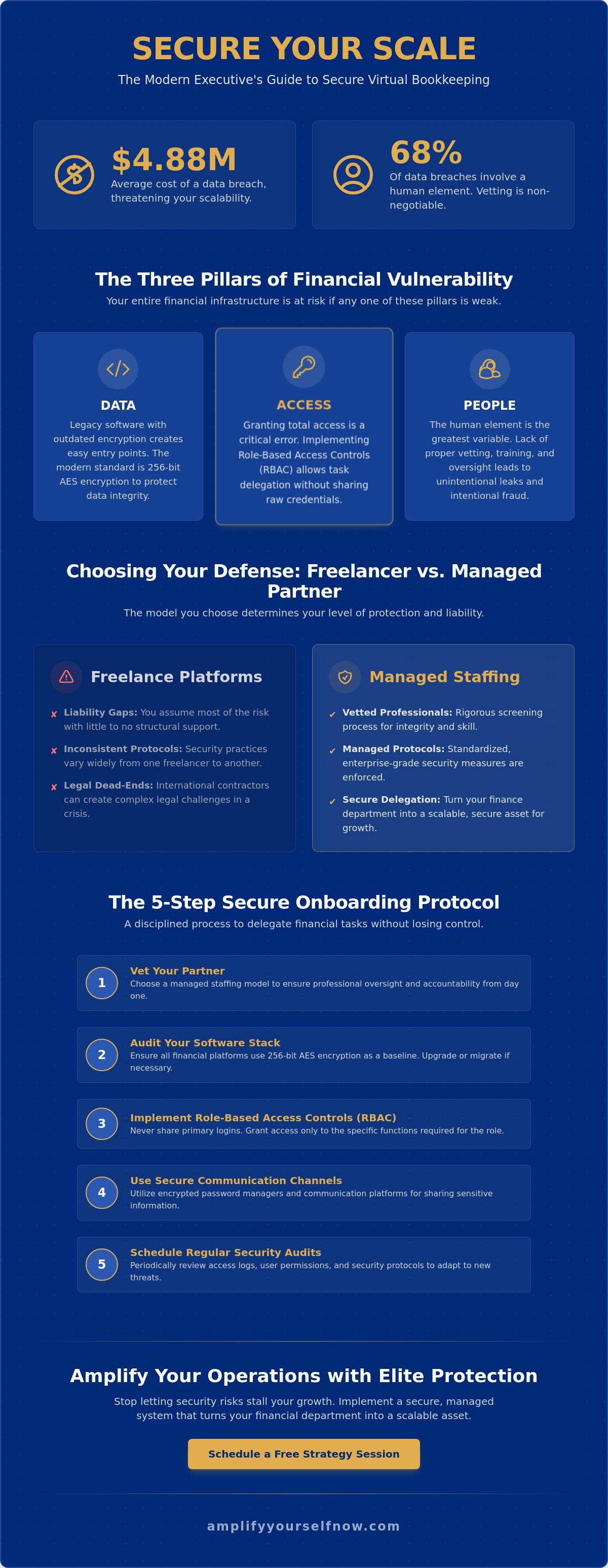
According to the 2024 IBM Cost of a Data Breach Report, the average financial impact of a security failure has climbed to $4.88 million. For an executive focused on expansion, the security risks of virtual bookkeeping aren't just IT concerns; they are existential threats to your scalability. You understand that you can't reach the next level while manually reconciling every invoice, yet the thought of a remote worker having total access to your bank accounts likely keeps you up at night. It's a valid concern in an era where 68% of data breaches involve a human element.
You deserve the freedom to focus on high-level strategy without wondering if your international contractor provides a legal dead end in a crisis. This guide will help you move past that anxiety by identifying real vulnerabilities and implementing the managed protocols that turn remote finance into a secure asset. We will cover a comprehensive security checklist and the vetting process used by high-performers to ensure their data remains impenetrable. If you're ready to amplify your operations now with a vetted partner, you can schedule a strategy session at https://amplifyyourselfnow.com/appointment to secure your systems today.
Key Takeaways
- Identify the primary security risks of virtual bookkeeping by analyzing the critical vulnerabilities found in software encryption, access points, and the human element.
- Learn why traditional in-office management is no longer the gold standard and how to transition to a more secure, cloud-based financial system.
- Compare the liability gaps between freelance platforms and managed staffing models to determine which environment offers the best protection for your sensitive data.
- Discover the essential onboarding steps, including Role-Based Access Controls, that allow you to delegate financial tasks without sharing raw credentials.
- Explore how secure delegation through managed Filipino bookkeepers can turn your financial department into a scalable asset for business growth.
Understanding the Security Risks of Virtual Bookkeeping in 2026
Virtual bookkeeping is a cloud-based financial management system. Remote professionals handle your books through encrypted platforms and real-time data feeds. The old ways are dead. Traditional, in-office bookkeeping no longer holds the gold standard for security. Local servers are physical liabilities. Paper trails are security leaks waiting to happen. To scale your business in 2026, you must master decentralized data. The primary driver of the security risks of virtual bookkeeping is improper access management. Your goal is elite-level financial oversight. You need data integrity that supports rapid growth without compromise.
To better understand this concept, watch this helpful video:
The Reality of Modern Financial Data Threats
Small businesses face 43% of all cyberattacks. It's a staggering reality. Most founders worry about a direct theft of funds. That is a perceived risk. The actual security risks of virtual bookkeeping often stem from unintentional leaks. By 2026, sophisticated AI bots scan for weak internal control procedures with terrifying speed. One misconfigured cloud permission can expose your entire cash flow history. You aren't just protecting money; you're protecting your reputation and your competitive advantage. Amplify your defense now before a breach forces your hand.
Why "Doing It Yourself" Is Often Riskier
Founder fatigue is a silent killer. When you're exhausted, you reuse passwords. You skip two-factor authentication to save five seconds. This creates a massive vulnerability. Professional virtual bookkeeping introduces standardized security discipline. They use enterprise-grade tools you haven't even implemented yet. Consider the cost of inaction. Messy books and loose permissions create more long-term liability than remote access ever will. Stop playing small with your security. If you're ready to secure your perimeter and scale your operations, book an appointment to audit your current workflow. Elite performance requires elite protection.
- Standardization: Professional systems eliminate human error in data entry.
- Redundancy: Cloud backups ensure your data survives even if your hardware fails.
- Encryption: Modern platforms use 256-bit AES encryption as a baseline.
The transition to a virtual model isn't just about convenience. It's about leverage. You're moving from a fragile, localized system to a resilient, global one. This is how you reclaim your time and focus on high-level strategy. Don't let the fear of the unknown stop your progress. Mastery of your finances starts with securing the tools you use to manage them. Amplify your business potential by delegating to those who live and breathe security protocols every day.
The Critical Vulnerabilities: Data, Access, and the Human Element
The security risks of virtual bookkeeping center on three specific pillars: the software stack, the level of access you grant, and the integrity of the individual handling your ledger. If any one of these pillars is weak, your entire financial infrastructure is at risk. You cannot scale a business on a foundation of digital sand. As we move into 2026, the complexity of these risks has evolved. It's no longer just about preventing a simple password leak; it's about defending against sophisticated data exfiltration and ensuring compliance with tightening global privacy laws.
Legacy accounting software often relies on outdated encryption standards that create easy entry points for breaches. While many platforms claim to be secure, they often lack the 256-bit AES encryption required by modern standards. By 2026, updated US privacy laws and GDPR iterations will demand more than just basic "browser-based" protection. These regulations now hold executives personally accountable for how remote contractors handle sensitive data. You must ensure your systems protect data both in transit and at rest to maintain operational integrity.
Software and Cloud Storage Vulnerabilities
There is a massive difference between "browser-based" security and "bank-level" encryption. Browser security often relies on the user's local settings, which are frequently outdated or misconfigured. Bank-level encryption ensures that even if data is intercepted, it remains unreadable. Using unvetted, third-party apps for quick file sharing is a major liability that many entrepreneurs overlook. These apps often lack the audit trails necessary for financial accountability. To protect your assets, you should follow FTC cybersecurity guidelines which emphasize the following protocols:
- Implementation of multi-factor authentication (MFA) across all financial portals.
- Use of encrypted password managers to prevent credential stuffing attacks.
- Establishment of automated, off-site backups to ensure rapid disaster recovery.
- Regular software patches to close vulnerabilities in legacy systems.
The Human Factor: Vetting and Accountability
The "Insider Threat" remains the number one concern for 74% of CEOs in the current fiscal year. This isn't always about malicious intent; it's often about negligence or a lack of standardized training. A resume is not a security document. It proves what someone has done, not who they are or how they handle your private data under pressure. You need a multi-stage vetting process that includes criminal background checks and credit history reviews to mitigate the security risks of virtual bookkeeping.
Accountability changes in a remote environment. Without physical oversight, you must rely on systems of record and psychological accountability. This is why many high-performing firms hire a professional virtual assistant philippines through established agencies. These agencies enforce strict operational standards and security protocols that independent freelancers rarely maintain. They provide a layer of institutional trust that allows you to amplify your output without increasing your risk profile. If you want to review your current security posture while you scale, you can schedule a strategy session to align your operations with 2026 standards.
Managed Staffing vs. Freelance: Which Model Protects Your Data?
Scaling your business requires a definitive choice between the transactional gig economy and structured managed staffing. This decision dictates your exposure to the security risks of virtual bookkeeping. Freelance platforms often operate like a digital frontier. They offer speed and low entry costs but frequently lack the rigorous infrastructure required for high-level financial data protection. When you hire a solo freelancer, you're often inheriting their "Shadow IT" setup. This includes personal laptops, unencrypted home Wi-Fi, and unsecured browser extensions. A 2023 Ponemon Institute report found that 54% of organizations suffered a data breach caused by one of their third parties. You can't audit a freelancer's router or verify if their workspace is private. The liability rests entirely on your shoulders if a breach occurs.
The Gig Economy Trap
Popular freelance marketplaces prioritize volume over verification. They don't vet the physical security of a worker’s environment or their hardware. High turnover is the standard in this model. This creates a massive risk of "orphan" access accounts. When a gig worker moves to the next project, their credentials often remain active in your software, providing a silent backdoor into your ledger. It's a transactional relationship that lacks the accountability needed for 2026 compliance standards. You aren't hiring a partner; you're hiring a temporary user with full access to your bank feeds.
The Managed Agency Advantage
Professional agencies like Amplify Yourself take a different path by owning the onboarding security phase. This isn't just about finding a resume. It's about hardware verification, mandatory VPN usage, and multi-factor authentication (MFA) enforcement from day one. You're investing in a system that includes ongoing performance monitoring and dedicated HR support. This structure mitigates the security risks of virtual bookkeeping by ensuring the person handling your numbers is part of a managed ecosystem. For a deep dive into how we filter for elite talent, review our hiring guide.
Managed VAs function as strategic partners rather than gig workers. They follow a defined virtual bookkeeping workflow that centralizes accountability and minimizes data sprawl. If you're ready to secure your financial operations and scale without the "Wild West" risks of unmanaged freelancers, schedule a call today to see how we protect your firm’s legacy.
The Security Protocol: 5 Steps to Safely Onboard a Remote Bookkeeper
Scaling your business requires speed, but moving fast without a safety net is a recipe for disaster. To mitigate the security risks of virtual bookkeeping, you need a repeatable framework that protects your capital while empowering your team. Follow these five steps to lock down your financial data before you share a single login.
- Step 1: Implement a Password Manager. Stop sending passwords via text or chat. Use LastPass or Dashlane to share access without revealing raw credentials. This ensures you retain total ownership of the keys to your kingdom.
- Step 2: Use Role-Based Access Controls (RBAC). Never give a bookkeeper full administrative rights. Limit their permissions to entry-only or view-only modes. They should be able to categorize a transaction, but they shouldn't be able to change your primary account settings.
- Step 3: Mandate Multi-Factor Authentication (MFA). This is your most critical line of defense. According to Microsoft’s 2023 Digital Defense Report, MFA blocks over 99.9 percent of account compromise attacks. Require it for every financial and communication platform you use.
- Step 4: Establish a Clear Communication Channel. Unencrypted email is a playground for hackers. Use secure platforms like Slack or Signal for sensitive discussions. If a document contains a tax ID or bank number, it doesn't belong in an inbox.
- Step 5: Conduct Regular Security Audits. Set a recurring calendar invite to review access logs every 30 days. If a contractor’s role has changed or a project has ended, revoke their permissions immediately.
Mastering Access Control
The Principle of Least Privilege (PoLP) is the gold standard for elite operators. It means giving a team member the minimum level of access necessary to complete their job. For your bank accounts, this translates to "View Only" access. Your bookkeeper can reconcile transactions and pull statements for the 2026 tax season without having the authority to move a single dollar. If a contract ends, your offboarding checklist must be executed within 60 minutes. Speed in revocation is just as important as care in onboarding.
Tools for Secure Collaboration
Modern scaling demands 2026-standard tools like AES-256 encrypted file sharing and hardware security keys. Managing this tech stack can become a full-time job. This is why a dedicated executive virtual assistant should manage these protocols for you. They ensure your VPNs are active and your bookkeeper is operating on a secure, private network rather than public Wi-Fi. This layer of oversight allows you to focus on high-level strategy while your data remains insulated from the common security risks of virtual bookkeeping.
Ready to amplify your operations with a team that prioritizes your security? Schedule your strategy session now to build a secure, scalable back office.
Strategic Leverage: Why a Managed Filipino Bookkeeper is Your Most Secure Option
You've examined the security risks of virtual bookkeeping from every angle. It's clear that the greatest risk isn't the technology itself; it's the lack of a structured system for managing it. When you transition from a mindset of fear to one of strategic delegation, you unlock the ability to scale your business without the weight of administrative backlogs. Security becomes the foundation for your next breakthrough.
The Filipino professional market offers a unique combination of cultural integrity and professional loyalty. In a 2023 industry survey, 92% of US based entrepreneurs reported that their Filipino team members showed higher retention rates compared to local hires. This loyalty is a security feature in itself. A bookkeeper who stays with your firm for years understands your data patterns and can spot anomalies faster than a rotating door of freelancers. At Amplify Yourself, we don't just find you a candidate. Our vetting process is rigorous. Only the top 1% of applicants make it through our skills testing and background checks. This ensures your financial data is handled by an elite operator from the start.
Building a Culture of Security
Security starts on day one. You must set clear expectations for data handling immediately. Hiring a bookkeeping specialist who is already fluent in US accounting standards and GAAP principles removes the learning curve. These professionals understand the sensitivity of tax IDs and bank access. Having an agency provide ongoing support acts as your ultimate insurance policy. If a technical issue arises or a protocol needs updating, you have a partner to manage the transition. This layer of oversight mitigates the security risks of virtual bookkeeping that often plague solo entrepreneurs who try to manage everything themselves.
Take the Next Step Toward Mastery
Stop being the bottleneck in your own growth. Every hour you spend reconciling accounts or worrying about data leaks is an hour you aren't spending on high level strategy. You can't reach the elite level if you're bogged down in the weeds of your ledger. It's time to leverage the talent available to you and amplify your results. Clarity in your numbers leads to clarity in your decision making.
Don't let the fear of what could go wrong stop you from doing what's necessary. Secure your books and reclaim your time. If you're ready to stop playing small and start scaling with confidence, schedule a strategy call with us today. We'll discuss your specific staffing needs and how to build a secure, scalable back office. Leverage is the only path to the top. Start now.
Secure Your Scale for 2026 and Beyond
Scaling your business requires moving past the DIY phase; however, you can't ignore the inherent security risks of virtual bookkeeping. You've seen how freelance models often lack the oversight needed to protect sensitive financial data. By 2026, the standard for elite operations shifts toward managed staffing solutions that prioritize data integrity. Implementing a 5-step onboarding protocol isn't just a suggestion; it's a requirement for operational safety.
We eliminate these vulnerabilities through a multi-stage vetting process for every candidate we present. Our bookkeepers don't just have general experience; they undergo specialized training in US-based accounting software to ensure technical mastery. With ongoing HR support and constant performance monitoring, your financial data remains in a controlled, professional environment. This level of leverage allows you to focus on high-level strategy while we handle the technical execution.
Ready to scale securely? Schedule your appointment to find your vetted bookkeeper now.
It's time to amplify your results by building a foundation that won't crack under pressure. Your growth depends on the quality of your team and the strength of your systems.
Frequently Asked Questions
Is it safe to give a virtual bookkeeper access to my bank account?
Yes, provided you use view-only access credentials rather than sharing primary login details. Most major banks, including Chase and Wells Fargo, offer specific accountant logins that prevent fund transfers while allowing transaction downloads. This setup eliminates the risk of unauthorized withdrawals while giving your bookkeeper the data they need to reconcile accounts. It's a standard practice that keeps your capital safe while you scale your business operations.
What happens if my virtual bookkeeper makes a mistake or a security breach occurs?
You should have a clear Professional Liability Insurance policy and a signed Data Processing Agreement that outlines liability before work begins. In 2024, industry standards require breach notification within 72 hours. If a mistake happens, your contract should specify the remediation steps, such as correcting ledger entries or covering late fees incurred by their error. Clear documentation ensures that accountability is established before the first transaction is ever recorded.
How do I know a remote bookkeeper in the Philippines is actually vetted?
You verify their credentials through the Professional Regulation Commission in the Philippines and check for a clean NBI Clearance, which is the local equivalent of an FBI background check. Amplify Yourself vets candidates by reviewing these documents and conducting 3 stage technical assessments. We ensure every hire understands the security risks of virtual bookkeeping and follows ISO 27001 data protection protocols to maintain the highest standards of integrity.
Can I limit what my virtual bookkeeper sees in my accounting software?
You can use role-based access control within platforms like QuickBooks Online or Xero to restrict permissions to specific modules. For example, you can grant access to Accounts Payable but block the ability to view payroll or sensitive tax documents. This "least privilege" approach is a fundamental strategy to mitigate the security risks of virtual bookkeeping by ensuring staff only see what's necessary for their specific tasks and nothing more.
Do I need to provide a laptop or specialized security software for a remote VA?
You don't necessarily need to provide hardware, but you must mandate the use of a secure, company-managed Virtual Private Network and a password manager like LastPass. Requiring two-factor authentication on all work devices is non-negotiable for remote operations. Setting these standards ensures your financial data stays encrypted regardless of the physical device being used. It's about creating a secure digital environment that exists independently of the hardware itself.
What is the most common security mistake entrepreneurs make when hiring remote staff?
The most frequent error is sharing master passwords via unencrypted chat apps like Slack or WhatsApp. Statistics show that 81 percent of data breaches are caused by weak or stolen passwords. Instead of messaging credentials, use a secure sharing tool that allows the bookkeeper to log in without ever seeing the actual password. This simple shift in execution protects your most sensitive gateways from being compromised by basic human error.
How does Amplify Yourself ensure the security of my financial data?
We implement a multi-layered security framework that includes rigorous background checks, mandatory two-factor authentication, and encrypted communication channels. Our system is designed to help you scale safely by removing the guesswork from delegation. If you're ready to secure your operations and amplify your results, you can book a strategy session at https://amplifyyourselfnow.com/appointment to discuss your specific needs. It's time to move toward elite business mastery with total confidence.

READY TO GIVE US A TRY?
Get Started for Free Today!
We'll connect you with top overseas talent for all your business endeavors.
Call 925-515-9343
Email: [email protected]


Privacy Policy | ©2025 Amplify Yourself, LLC. All Rights Reserved
Instagram
LinkedIn