
Transform your business
...with virtual assistants
Latest Blog Posts

Outsource Bookkeeping for Small Business: A Strategic Guide to Financial Leverage
Your weekend spent wrestling with bank reconciliations isn't just a chore; it's a $500 per hour strategic error that's actively stalling your growth. High-performers understand that true leverage comes from delegating every task that doesn't directly amplify their core genius. You've likely felt the weight of missed deductions or the nagging fear of an IRS audit during tax season. It's time to outsource bookkeeping for small business functions to reclaim your time and sharpen your competitive edge. Now is the moment to stop acting as your own data entry clerk and start acting as the visionary leader your company requires.
You already know that real-time financial visibility is the only way to make informed decisions, yet you're likely losing 12 hours every month to manual entries. This article will show you exactly how to reclaim those 144 hours a year while ensuring 100% financial accuracy across your entire operation. We'll break down the strategic framework to transition your books to an elite remote team that delivers audit-ready reports every 30 days, allowing you to scale without the $150 per hour cost of local CPAs.
Key Takeaways
-
Learn how to escape the "Founder’s Trap" by reclaiming over 10 hours a week to focus on high-level growth and strategic scaling.
-
Evaluate the strengths and weaknesses of different models to effectively outsource bookkeeping for small business needs, from automated software to virtual assistants.
-
Discover how to transition from basic record-keeping to proactive financial analysis that protects your business from errors and internal fraud.
-
Identify the specific steps required to standardize your tech stack and document workflows for a seamless transition to an outsourced team.
-
Understand why leveraging specialized offshore talent is the most efficient way to build a high-performance financial department without the overhead of a traditional firm.
Table of Contents
Why Small Businesses Must Outsource Bookkeeping to Scale
Running a business requires you to master the art of leverage. Many founders fall into a trap where they believe saving a few hundred dollars by handling their own accounts is a win. It is not. When you choose to manage your own
[bookkeeping
](https://en.wikipedia.org/wiki/Bookkeeping), you are essentially hiring a high-priced CEO to perform $25-an-hour tasks. This decision creates an immediate ceiling on your growth. To scale effectively, you must outsource bookkeeping for small business operations to ensure your focus remains on high-leverage activities like sales and product development.
The difference between a struggling startup and an elite enterprise often comes down to financial clarity. Reactive accounting involves looking at your bank balance to see if you can afford a new hire. Proactive financial management involves using real-time data to project cash flow 12 months into the future. Without professional oversight, you are flying blind. Clean, professional books are not just for your own peace of mind. They are a requirement for external growth. A 2023 study by the Small Business Administration found that businesses with accurate, up-to-date financial records are 50% more likely to secure traditional bank loans compared to those with disorganized accounts.
To better understand how this transition works, watch this helpful video:
The Real Cost of "Doing it Yourself"
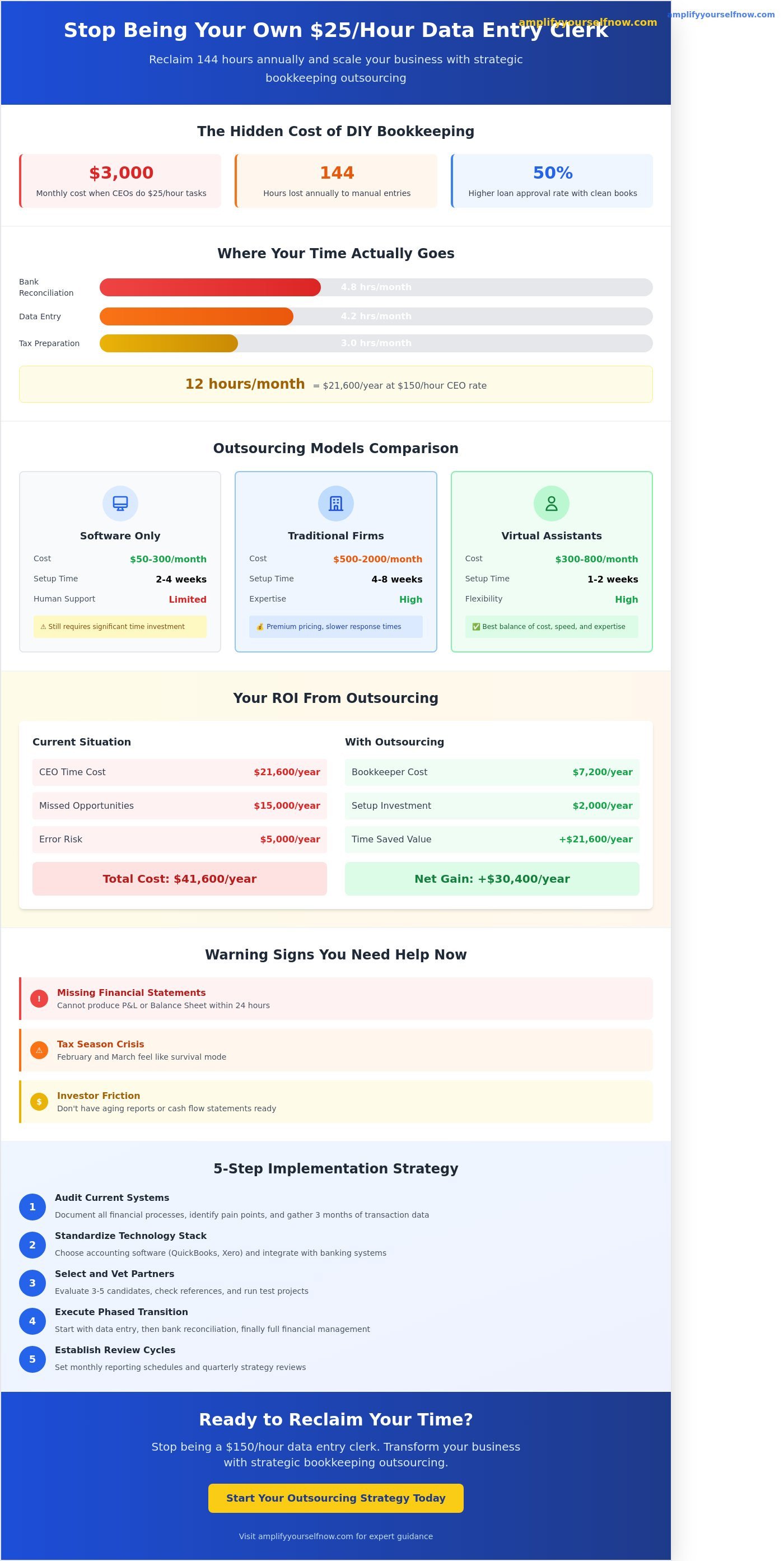
Calculate your true hourly rate. If your time is worth $150 per hour and you spend five hours a week on data entry, you are spending $3,000 a month on basic administration. Hiring a dedicated bookkeeper costs a fraction of that amount, instantly freeing up 20 hours a month for revenue generation. Beyond the time loss, the hidden expenses of DIY management are staggering. Missing a single tax deduction of $5,000 because of poor record-keeping costs you more than an entire year of professional service. Late filing fees, such as the $210 per month penalty for late S-corp returns, further erode your capital. Manual data entry is the lowest-leverage activity a CEO can perform.
Signs Your Business Has Outgrown In-House Bookkeeping
You cannot wait until tax season to understand your profitability. If you are more than 30 days behind on your bank reconciliations, your data is already obsolete. You need to identify performance trends as they happen, not six months after the fact. Look for these specific indicators that your current system is failing:
-
Missing Financial Statements: You cannot produce an accurate Profit & Loss statement or Balance Sheet within 24 hours of a request.
-
Tax Season Crisis: February and March feel like a survival exercise rather than a standard administrative window.
-
Investor Friction: Potential partners or lenders ask for specific aging reports or cash flow statements that you do not have ready.
Delegating these complex compliance tasks to a specialist provides a psychological breakthrough. It removes the low-level anxiety of potential audits and missed deadlines. When you outsource bookkeeping for small business needs, you replace chaos with a system of absolute clarity. This is how you reclaim your mental bandwidth and focus on building a legacy. Now is the time to stop playing small and start operating like the leader your business requires. Reach for mastery by putting your financial foundation in the hands of experts.
Comparing Outsourcing Models: Software vs. Firms vs. VAs
Choosing the right partner determines your trajectory. Most entrepreneurs realize they need help when financial tasks consume more than five hours of their week. The U.S. Small Business Administration suggests that most successful entrepreneurs outsource at least some of their operations to maintain focus on growth. However, the market offers three distinct paths, and picking the wrong one leads to expensive friction. You must evaluate these models based on your current revenue and the complexity of your transactions. If you decide to outsource bookkeeping for small business, the goal is to buy back your time while increasing data accuracy.
Software-Only Solutions: The Limitations
Automated software platforms promise a "hands-off" experience for a low monthly subscription. This is often a trap for the growing business. While AI excels at matching recurring receipts, it lacks the context required for nuanced categorization. A 2023 industry report found that AI-only systems still require human intervention for approximately 22% of all transactions to avoid misclassification. Without oversight, your ledger becomes a "garbage in, garbage out" system. You shouldn't spend your Sunday nights correcting software errors. When a tool requires more management than the task it was meant to solve, it's no longer a tool; it's a liability. Software alone cannot provide the strategic clarity you need to amplify your cash flow.
Traditional accounting firms represent the opposite end of the spectrum. These organizations provide high-level expertise but often at a price point that doesn't align with daily operational needs. Most firms charge between $150 and $400 per hour. They focus heavily on tax compliance and year-end filings rather than real-time financial health. For a business generating $500,000 in annual revenue, a full-scale firm is usually overkill. You're paying for a sledgehammer when you need a scalpel. These firms also tend to operate on a 30-day lag, meaning you're making decisions based on old data. High-performers require real-time visibility to move fast.
The Dedicated Virtual Bookkeeper Advantage
The managed virtual assistant (VA) model offers a middle ground that balances cost and precision. Unlike a software subscription, a dedicated bookkeeper understands your specific vendor relationships and growth goals. They build customized workflows that adapt as you scale. This model provides a single point of contact who knows your history, eliminating the need to explain your business model every month. You can access affordable pricing for elite talent that handles the heavy lifting of reconciliation and reporting. This approach allows you to outsource bookkeeping for small business without losing the human touch that prevents costly tax errors.
-
Phase 1 (Under $250k Revenue): Use software with a part-time VA to keep costs low while ensuring clean data.
-
Phase 2 ($250k - $1M Revenue): Transition to a managed service for weekly reconciliations and basic financial reporting.
-
Phase 3 (Over $1M Revenue): Implement a hybrid model with a dedicated bookkeeper and a fractional CFO for strategic tax planning.
Execution is the only metric that matters. If your current system doesn't provide a clear profit and loss statement by the fifth of every month, you're flying blind. Real leverage comes from having a system that runs without your constant input. Start scaling your operations by choosing the model that fits your stage of growth today. Now is the time to move from being a technician in your books to the visionary of your brand. Mastery of your numbers is the first step toward absolute business clarity.
The ROI of Outsourced Financial Management
Stop treating your books like a compliance burden. They're a growth engine. When you outsource bookkeeping for small business operations, you transition from reactive record keeping to proactive strategic analysis. You aren't just recording what happened last month; you're predicting what happens next. Most owners spend at least 10 hours every month on manual data entry. That's 120 hours a year stolen from high-level business development and sales. Reclaiming that time is the first major return on your investment.
Internal fraud is a silent killer for growing companies. The ACFE 2022 Report to the Nations found that small businesses suffer median losses of $150,000 per fraud instance. This happens because one person often handles all the money. An outsourced agency provides a necessary separation of duties. They act as a third-party watchdog, catching errors and irregularities before they become terminal liabilities. You get a level of oversight that's impossible to maintain in a small, local office setup.
Scaling your business shouldn't mean paying more rent. Hiring a local bookkeeper in the US costs an average of $48,000 to $62,000 per year, plus benefits and payroll taxes. You also have to provide a desk. With average office space costing $35 per square foot, a single new hire adds thousands in annual overhead. When you outsource bookkeeping for small business, you access elite talent without increasing your physical footprint. You scale your back-office capacity instantly without signing a longer lease or buying more hardware.
Real-time cash flow visibility is your ultimate competitive advantage. If you wait 30 days for a monthly report, you're making decisions based on old news. High-performers use real-time data to pivot within 24 hours. This agility allows you to seize market opportunities or cut losing projects before they drain your reserves. You gain total clarity on your burn rate and your runway, allowing for aggressive expansion while your competitors are still guessing at their margins.
Security and Data Protection Protocols
Protecting your capital requires more than just trust. It requires systems. Use password managers like Bitwarden or LastPass to share access without revealing actual credentials. Always enforce two-factor authentication (2FA) for every financial tool. A professional agency adds a vital layer of security by vetting staff through rigorous background checks and continuous monitoring. They ensure your remote professionals only have the specific, limited access necessary to perform their tasks, keeping your primary accounts shielded.
Measuring Success Beyond the Balance Sheet
True ROI shows up in your schedule, not just your bank account. Track the hours returned to the CEO. If your time is worth $250 per hour, saving 15 hours a month generates $3,750 in reclaimed executive capacity. You'll also see a direct impact during tax season. Clean, professional books typically reduce year-end CPA fees by 30% because the tax preparer doesn't have to spend hours reconciling messy data. Finally, precise job costing ensures every project hits its 20% or 30% profit target, stopping the "profit leak" common in unmonitored small businesses.
How to Implement an Outsourced Bookkeeping Strategy
Success isn't accidental; it's engineered. To outsource bookkeeping for small business operations effectively, you must move from a reactive state to a proactive system. This transition requires a tactical blueprint that prioritizes speed, accuracy, and absolute transparency. Stop treating your finances like a back-office chore and start treating them like a high-performance engine that drives your expansion. Implementation is the bridge between where you are and where you want to be.
Your strategy must be built on these five critical pillars to ensure maximum leverage:
-
Step 1: Standardize your tech stack. Use QuickBooks Online, Xero, or Sage. According to a 2023 industry survey, 64% of small businesses use cloud accounting to reduce manual errors. These platforms provide the infrastructure needed for a 24/7 financial overview.
-
Step 2: Document your specific financial workflows. Map out how invoices are generated, how expenses are categorized, and who approves large expenditures. If a process isn't written down, it doesn't exist. This clarity eliminates 90% of future communication friction.
-
Step 3: Define clear communication channels and monthly deadlines. Elite operators don't wait for updates; they set the rhythm. Use tools like Slack for quick queries and set a non-negotiable deadline. If your books aren't closed by the 10th of the following month, you're making decisions based on old news.
-
Step 4: Establish a phased onboarding process. Don't hand over the keys to the kingdom on day one. Start with a limited scope, such as basic bank reconciliation, for the first 15 days. As the bookkeeper proves their accuracy, expand their access to accounts payable and payroll.
-
Step 5: Review monthly reports to refine business strategy. This is where you move from operator to visionary. A 2022 study by U.S. Bank found that 82% of business failures are due to poor cash flow management. Use your reports to ensure you aren't part of that statistic.
Execution is the only variable that matters. By deciding to outsource bookkeeping for small business growth, you're choosing to reclaim your time for high-value tasks. You aren't just hiring a service; you're installing a financial department that scales with your ambition. The goal is a seamless flow of data that allows you to pivot instantly when opportunities arise.
Selecting Your Accounting Software
Cloud-based platforms are the only option for elite remote collaboration. They allow you to integrate bank feeds and payment processors like Stripe or PayPal, automating up to 70% of manual data entry. Security is paramount. Always provide your remote team with "View Only" access to bank accounts. This ensures they can reconcile transactions without having the authority to move funds. It's about maintaining absolute control while enabling rapid execution.
Onboarding Your Virtual Bookkeeper
Your first 30 days are a diagnostic phase. Use this window to audit existing books and clean up historical errors that may be hiding in your ledger. Create a recurring task list that breaks duties into daily, weekly, and monthly buckets. This structure prevents bottlenecks and sets a standard of excellence. When providing feedback, focus on the output rather than the keystrokes. Avoid micromanaging. If the reporting is accurate and the deadlines are met, your system is winning. Amplify your results by trusting the process you built.
Ready to scale? Amplify your financial clarity now and take control of your growth.
Amplify Your Results: The Managed Recruitment Solution
Scaling a company requires more than just hard work; it requires the right infrastructure. The Philippines has established itself as the global hub for financial talent because of its rigorous educational standards and cultural alignment with Western business practices. With a national literacy rate of 96% and a professional accounting curriculum that mirrors US GAAP, the region produces over 8,000 new accountants every year. When you choose to outsource bookkeeping for small business needs through this corridor, you access a level of precision that is often unavailable or unaffordable in local markets.
Amplify Yourself, LLC doesn't settle for average results. Our vetting process is designed to filter for the top 1% of virtual bookkeepers. Every candidate undergoes a four-hour technical evaluation, a deep-dive behavioral interview, and a live software proficiency test. We review approximately 500 applications for every single placement we make. This level of scrutiny ensures that your financial data is handled by an expert who understands the nuances of cash flow management and tax readiness. We prioritize candidates with at least five years of experience in cloud-based accounting platforms to ensure immediate technical mastery.
Efficiency is our priority. Most business owners wait until they are at a breaking point to seek help. Our managed recruitment model takes you from a state of being overwhelmed to having a fully onboarded professional in exactly seven days. We maintain a pre-vetted talent pool, which eliminates the traditional 60-day hiring cycle. Once your bookkeeper is in place, we provide ongoing performance monitoring and monthly quality audits to ensure your standards never slip. Our success rate for long-term placements currently sits at 94% after the first year of service.
Beyond Bookkeeping: Building Your Remote Executive Team
A bookkeeper manages the past, but an Executive Virtual Assistant manages your future. Integrating these roles creates a robust administrative engine. Your bookkeeper handles the ledgers while your EVA manages the documentation fueling those numbers. You can scale further by adding CSR support to handle billing inquiries. This ecosystem allows you to step out of daily operations and focus on high-level strategy.
Your Next Move: Strategic Delegation
You can't build a high-growth company on ten-dollar tasks. Every hour spent on data entry is an hour stolen from business development. If your time is worth $500 an hour, doing your own books is a massive financial leak. Choosing to outsource bookkeeping for small business operations isn't a cost; it's an investment in leverage. This shift reclaims 15 to 20 hours of executive time monthly. Amplify your business operations starting today.
Master Your Financial Momentum
You've seen how manual data entry slows your growth. To scale, you must move from working in your business to working on it. When you outsource bookkeeping for small business operations, you reclaim up to 15 hours of high-value leadership time every single week. This transition isn't just about saving money; it's about gaining the clarity needed to make 100% data-driven decisions. By leveraging a managed staffing model, you eliminate the risks of solo contractors and the overhead of local firms.
Amplify Yourself Now provides access to elite, vetted talent from the Philippines. We handle the heavy lifting, ensuring your new specialist is integrated and onboarding in as little as 7 days. You get more than a bookkeeper; you get a managed solution with ongoing HR support that protects your investment. Don't let administrative friction stall your momentum. The time to optimize your back office is right now.
Amplify Your Growth: Hire a Dedicated Virtual Bookkeeper Now
The path to mastery starts with the right leverage. Your next breakthrough is ready when you are.
Frequently Asked Questions
Is it safe to outsource bookkeeping to a virtual assistant?
Outsourcing bookkeeping to a virtual assistant is safe when you implement strict security protocols and encrypted access. Use tools like LastPass or 1Password to share login credentials without revealing actual passwords. You should also ensure they work on a secure VPN. Restrict their access to view-only modes on bank accounts to prevent unauthorized transfers. This level of control protects your assets while you leverage global talent to amplify your operations now.
How much does it cost to outsource bookkeeping for a small business?
The monthly cost to outsource bookkeeping for a small business usually ranges from $300 to $1,500 depending on transaction volume. This investment is significantly lower than the $45,000 average annual salary for a full-time in-house bookkeeper. By choosing a fixed-fee model, you eliminate the 20% in additional costs associated with employee benefits and office equipment. You gain predictable expenses and elite financial clarity starting today.
What software should I use for outsourced bookkeeping?
You should use cloud-based platforms like QuickBooks Online or Xero to maintain real-time visibility into your finances. QuickBooks currently holds approximately 80% of the small business market share; this makes it the standard for professional compatibility. These tools allow your bookkeeper to categorize transactions daily. You can then review data 24/7 through a mobile app. This setup ensures your data is ready for analysis at any moment.
Will an outsourced bookkeeper handle my tax filings?
Most outsourced bookkeepers focus on daily recording and reconciliation rather than final tax filings. They prepare the necessary financial statements, such as your Profit and Loss and Balance Sheet, which a CPA then uses for tax preparation. Approximately 70% of bookkeeping services end their workflow at the trial balance. This clear division of labor ensures your records are accurate for the March 15 or April 15 deadlines.
How do I manage a bookkeeper who is in a different time zone?
Manage a bookkeeper in a different time zone by establishing a 2-hour daily overlap for live communication. Use project management tools like Asana or Slack to track progress asynchronously. Setting a 24-hour turnaround time for queries ensures work continues while you sleep. This global model allows your business to operate around the clock. You amplify your productivity by ensuring financial tasks are completed before your workday begins.
What is the difference between a bookkeeper and a CPA?
A bookkeeper manages your daily financial transactions and ledger accuracy, while a CPA provides high-level tax strategy and legal representation. CPAs must complete 150 college credit hours and pass a rigorous four-part exam to earn their license. In contrast, bookkeepers focus on the mechanics of your cash flow. You need both to build a robust financial foundation. Use the bookkeeper for execution and the CPA for annual compliance.
How long does it take to see results after outsourcing my books?
You'll see the first results of a clean ledger within 30 days of onboarding. By the 90-day mark, you'll have enough historical data to identify 3 to 5 key spending trends. Outsource bookkeeping for small business tasks to free up roughly 10 hours of your time each month. Use those hours to focus on high-value activities that grow your revenue and amplify your results now.

READY TO GIVE US A TRY?
Get Started for Free Today!
We'll connect you with top overseas talent for all your business endeavors.
Call 925-515-9343
Email: [email protected]


Privacy Policy | ©2025 Amplify Yourself, LLC. All Rights Reserved
Instagram
LinkedIn