
Transform your business
...with virtual assistants
Latest Blog Posts

How to Manage a Virtual Assistant: The 2026 Executive Framework for Scaling
What if the primary constraint on your business growth is not a lack of talent, but a lack of management structure? Most entrepreneurs find that hiring a remote team member doesn't immediately solve their time problem. Instead, they often end up spending more time answering questions and correcting errors than they save. Learning how to manage a virtual assistant effectively is a technical skill that requires shifting from a task-based approach to a systems-based framework. It is about creating a predictable environment where your staff can perform at a high level without constant supervision.
This guide provides a clear, operational framework for turning a remote hire into a high-performing executive partner. We will examine the specific systems needed for successful onboarding, the communication protocols that prevent calendar bloat, and the performance metrics that ensure a positive return on investment. At Amplify Yourself, LLC, we focus on providing the management layer that allows businesses to scale sustainably. By following these practical steps, you can move away from micromanagement and build a self-driving team that supports your long-term objectives.
Key Takeaways
- Shift from assigning simple tasks to delegating authority so you can focus on high-level strategy and your "Zone of Genius."
- Master how to manage a virtual assistant by using a structured seven-day onboarding blueprint that creates a "Single Source of Truth" for your team.
- Implement an 80/20 communication workflow to favor asynchronous updates, which cuts down on meetings and eliminates unnecessary rework.
- Use outcome-based KPIs that track results rather than just measuring activity, ensuring your investment doesn't go to waste.
- Explore how a managed staffing model removes the burden of HR and performance monitoring, letting you scale without the traditional hiring headaches.
The Mindset Shift: From Micromanager to Visionary Leader
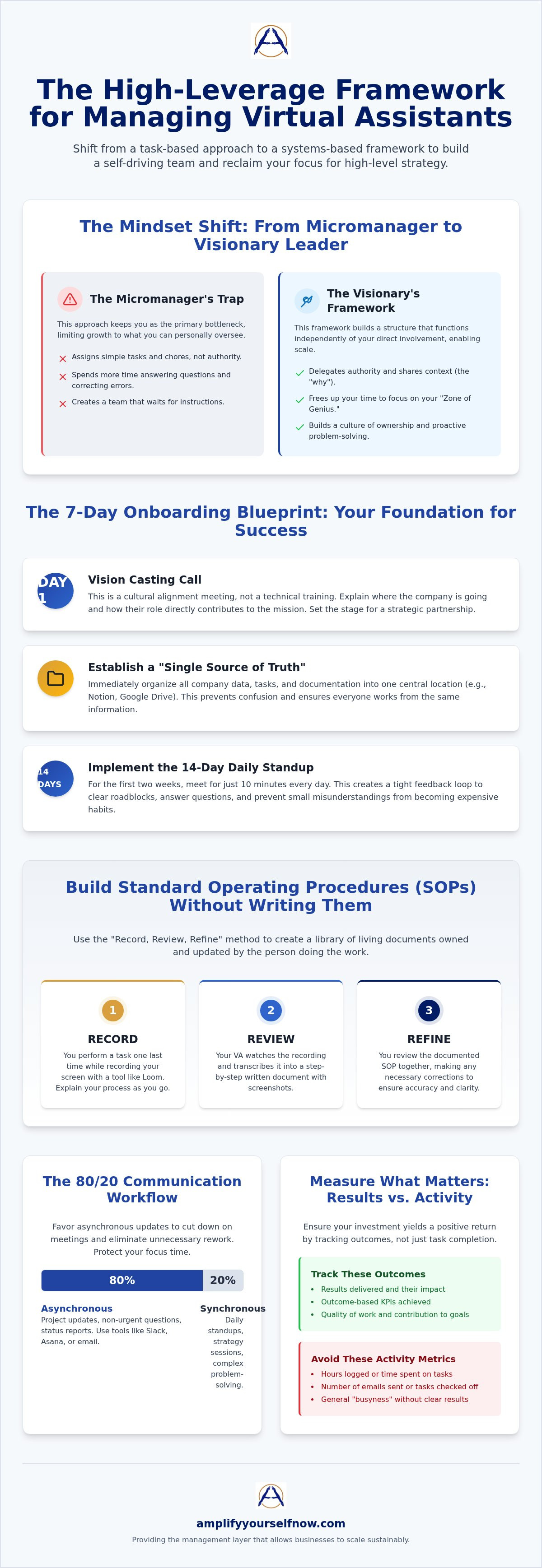
Effective business scaling requires a fundamental change in how you view your role as a manager. Many owners treat their assistants as simple task-receivers, which often results in the owner remaining the primary bottleneck. True management is the systematic process of delegating authority rather than just a list of chores. When you understand how to manage a virtual assistant through a leadership lens, you begin to build a structure that functions independently of your direct involvement.
To reach the next stage of growth, you must focus on your high-value activities. Every hour spent on routine administrative work represents a significant opportunity cost. Shifting these responsibilities to an Executive Virtual Assistant allows you to operate where your skills are most effective. This transition requires moving away from hiring a task-taker who waits for instructions and toward finding a strategic partner who can anticipate and solve operational challenges.
The Cost of the "Do It Myself" Trap
Attempting to maintain total control over every business function creates administrative friction. This friction limits your output to what you can personally oversee, effectively placing a ceiling on your company’s capacity. By refusing to delegate, you aren't protecting your standards; you're restricting your ability to handle more complex projects. Calculating the cost of your time helps clarify why holding onto low-level tasks is an inefficient use of resources.
Treating Your VA as a Strategic Asset
Successful delegation is rooted in providing context rather than just instructions. When you share the "why" behind a project, you empower your assistant to make informed decisions without needing to consult you at every step. This approach encourages a culture of ownership, where the assistant feels responsible for the final result. Understanding how to manage a virtual assistant as a strategic asset involves "insourcing" talent into your culture. If you're ready to implement this framework, you can schedule a strategy call to discuss your specific operational needs.
The Onboarding Blueprint: Setting the Foundation in 7 Days
A 60-minute checklist isn't onboarding. It's a recipe for confusion. To truly integrate a high-level partner into your operations, you need a structured seven-day plan that establishes culture, workflows, and security from the start. This initial week is the most critical phase of learning how to manage a virtual assistant because it sets the standard for every interaction that follows. If you rush this process, you'll spend the next six months fixing avoidable mistakes.
Day one must center on the Vision Casting Call. This isn't a technical training session; it's a cultural alignment meeting. Explain where the company is going and how their role directly contributes to that mission. Once the vision is clear, move immediately to technical organization by setting up a "Single Source of Truth." Whether you use Notion, Google Drive, or a dedicated project management tool, every piece of data and every task must live in one central location. To ensure rapid integration, implement the 14-day Daily Standup rule. For the first two weeks, meet for ten minutes every day to clear roadblocks and provide immediate feedback. This creates a tight loop that prevents small misunderstandings from becoming expensive habits.
Building Your Standard Operating Procedures (SOPs)
Effective delegation requires clear documentation, but you shouldn't be the one writing every word. Use the "Record, Review, Refine" method to build your library of SOPs. First, record yourself performing a task using Loom. Second, have your VA review the video and write the step-by-step instructions. Third, refine the document together to ensure accuracy. This process ensures your SOPs are living documents owned and updated by the person actually doing the work. For a deeper look at this process, you can download our comprehensive hiring and onboarding guide to streamline your setup.
Granting Access Without Sacrificing Security
Security is a primary concern when working with offshore talent, but it shouldn't stop you from delegating. Use a tiered access model to protect your business. Start by sharing only what's necessary for their immediate tasks and expand access as trust is earned. Utilize password managers like 1Password or LastPass to share credentials without ever revealing the actual passwords. This allows you to maintain total control over your systems and financial data while giving your assistant the tools they need to be productive. If you're concerned about the complexities of managing remote staff, you can schedule a strategy call to learn how a managed staffing model handles these security protocols for you.
The Communication Engine: Mastering Async and Sync Workflows
A high-performing remote partnership relies on communication systems that prioritize efficiency over constant presence. To master how to manage a virtual assistant, you should aim for an 80/20 communication split: 80% asynchronous and 20% synchronous. By reducing reliance on real-time meetings, you allow your assistant to focus on deep work while ensuring your own calendar remains open for strategic planning. This balance is a practical necessity for any business owner looking to scale without increasing their personal workload.
Eliminating rework starts with a clear "Definition of Done." Every task you assign should include a specific description of the final result, the required format, and the deadline. This clarity prevents the back-and-forth questions that often stall progress. While tools like Slack or Teams are useful for quick, high-speed updates, they should be supplemented by a Weekly Executive Briefing. This briefing is a structured report where your assistant summarizes progress, highlights completed milestones, and flags upcoming roadblocks. This ensures alignment without the need for a standing hour-long meeting.
Async Video: A Practical Feedback Tool
Asynchronous video is an effective way to provide complex feedback without the friction of a live call. Instead of writing a long email that might be misinterpreted, you can record a brief screen-share to walk through specific details. This method provides clear visual context and creates a searchable reference for your assistant. They can review the recording as needed, which reduces the likelihood of errors and builds a library of institutional knowledge that remains accessible as your team grows.
Centralizing Communication in Project Management
Relying on direct messages for task management often leads to fragmented information and missed deadlines. For a more reliable workflow, move all task-related communication into a central hub like Asana or Trello. This ensures that every project has a clear owner, a documented history, and a firm due date. Learn how an Executive VA manages your entire workflow to keep these systems organized and updated. Implementing a "No Task Without a Deadline" policy ensures that every item in your project management tool is actionable and accountable, allowing you to monitor progress at a glance rather than asking for status updates.
Performance Metrics: Tracking Output, Quality, and ROI
Measurement is the only antidote to mediocrity. If you want to master how to manage a virtual assistant, you must stop managing by "feel" and start managing by facts. You didn't hire a partner to wonder if they're working; you hired them to see results. Learning how to manage a virtual assistant effectively means moving from subjective "vibes" to objective data. Establishing clear Key Performance Indicators (KPIs) from day one ensures that both you and your assistant know exactly what success looks like. This clarity eliminates anxiety and builds a foundation of high-level accountability.
There is a massive difference between activity tracking and outcome tracking. Activity tracking is a micromanagement trap that focuses on mouse clicks and keyboard strokes. Outcome tracking focuses on value. For instance, a Lead Generation Specialist isn't successful because they sent 200 emails; they're successful because they booked five qualified meetings. Set Service Level Agreements (SLAs) for every recurring task to define the standard. If your Bookkeeper knows the monthly close must happen by the 5th, you never have to ask for an update.
The 4 Non-Negotiable KPIs for 2026
- Reliability: This is the baseline. It tracks on-time delivery and consistent attendance to ensure your operations never stall.
- Accuracy: Measure the percentage of tasks that require zero rework. High accuracy saves more time than high speed.
- Efficiency: Compare the actual time spent on a task against the estimated duration documented in your SOP.
- Proactivity: Track how many times your assistant anticipated a need or improved a process without being asked. This is the hallmark of an executive partner.
Conducting High-Impact Feedback Sessions
Monthly reviews should be data-driven coaching sessions, not casual chats. Use the "Observation, Impact, Change" (OIC) script to keep feedback objective. State exactly what you observed, explain the business impact of that action, and define the required change for the future. This method removes emotion from the equation and focuses on optimization. When mistakes happen, treat them as system failures first. Refine the process, then hold the person accountable to the new standard. Celebrating wins is equally vital. Recognizing high performance drives the loyalty and engagement needed for a long-term partnership. If you're ready to stop guessing and start scaling with a managed team, schedule a call with our experts to see how we handle performance monitoring for you.
The Managed Advantage: Why Scaling Requires a Strategic Partner
Hiring a remote team member is only the first step. The real challenge lies in the long-term maintenance of that relationship. Many entrepreneurs fall into the trap of unmanaged hiring, where they find a freelancer on a job board and hope for the best. This approach carries heavy hidden costs, including high turnover, inconsistent quality, and the administrative burden of handling payroll and HR. When you take on the full responsibility of how to manage a virtual assistant alone, you often find yourself working more, not less.
Amplify Yourself, LLC changes this dynamic through a managed staffing model. We don't just find talent; we build the management framework that allows that talent to thrive. By handling the recruitment, vetting, and onboarding within seven days, we remove the friction of traditional hiring. Our ongoing performance monitoring ensures that your Executive Virtual Assistant or Bookkeeper stays aligned with your goals. This shift allows you to move from managing individuals to leading a remote department, providing a measurable ROI on your staffing investment.
Beyond Recruitment: Ongoing Performance Support
A static hire is a risk to your growth. Our management layer ensures your assistant never goes stagnant by providing professional development and regular performance check-ins. Having a professional partner to manage offshore talent in the Philippines provides a level of cultural and operational bridge that most business owners can't build on their own. This structured support reduces turnover significantly because your team feels valued and supported. It transforms a simple hire into a long-term strategic asset that grows alongside your company.
Ready to Amplify Your Results?
Growth stops when you become the bottleneck. Take a moment to identify the repetitive tasks and administrative friction holding you back today. Whether you need a Lead Generation Specialist or a Social Media Manager, the path to your next executive partner takes only seven days. You've already learned the systems for how to manage a virtual assistant; now it's time to implement them with the right support. Schedule your strategy call and start scaling today to see how our managed model can give you the leverage you need.
Building Your Engine for Scale
Management isn't a personality trait; it's a discipline. You've now seen that the secret to true leverage lies in the systems you build, from the 7-day onboarding blueprint to the 80/20 communication rule. These components form a high-performance engine that allows you to step back from the daily grind and focus on legacy-level growth. Mastering how to manage a virtual assistant effectively means you stop being the operator and start being the architect of your own success.
You don't have to build this engine alone. Amplify Yourself, LLC provides the vetted talent and the ongoing performance monitoring needed to ensure your team remains a strategic asset. By leveraging our managed staffing model, you skip the recruitment headaches and move straight to execution. If you're ready to reclaim your time and scale with precision, schedule your appointment to build your remote dream team. The path to your highest potential is now clear.
Frequently Asked Questions
How do I track the hours my virtual assistant works?
Use dedicated time-tracking software like Hubstaff or Time Doctor to ensure transparency and accountability. These tools provide automated reports that simplify payroll and give you peace of mind. However, as you learn how to manage a virtual assistant at an executive level, shift your focus toward outcome-based tracking. Measuring results like completed projects or met KPIs is often more valuable than tracking every minute of the workday.
What is the best way to handle time zone differences?
Establish a "golden hour" of overlap where both you and your assistant are online at the same time. Use this window for high-priority sync calls or urgent clarifications that require immediate feedback. For the remaining hours, lean heavily on asynchronous tools like Slack and Loom. This approach ensures progress continues while you sleep, allowing your business to operate around the clock without requiring you to stay awake at odd hours.
How much should I pay for a high-quality virtual assistant in 2026?
Compensation for high-quality talent depends on the complexity of the role and the assistant’s specific expertise. A specialized Lead Generation Specialist or Bookkeeper will command different rates than a general administrative assistant. Focus on the value they bring to your operations rather than just the hourly cost. Investing in vetted, experienced talent typically results in a much higher ROI through increased efficiency and reduced turnover.
Can a virtual assistant handle sensitive financial data or bookkeeping?
Yes, a qualified assistant can securely manage sensitive data if you implement the right protocols. Use password managers like 1Password to grant access without sharing actual credentials. For financial tasks, hire a specialized Bookkeeper who understands standard accounting practices. By using tiered access and secure cloud-based software, you can delegate financial workflows while maintaining total control over your business assets and sensitive information.
What happens if my virtual assistant and I aren’t a good fit?
If the partnership isn't working, address the issue immediately through a data-driven feedback session. Sometimes a simple adjustment in communication style or a refined SOP fixes the problem. If the fit remains poor, a managed staffing model provides a significant advantage. We handle the transition and find a replacement who better aligns with your needs, ensuring your business operations don't skip a beat during the changeover.
How do I prevent my virtual assistant from becoming overwhelmed?
Prevent burnout by setting clear priorities and avoiding the trap of "task dumping." Use a project management tool to visualize their workload and ensure deadlines are realistic for their capacity. If you notice a dip in accuracy or speed, it’s often a sign of overcapacity. Regularly review their task list and move lower-priority items to a later date. This proactive approach is a key part of how to manage a virtual assistant for long-term sustainability.
What tools are essential for managing a remote team effectively?
You need a lean stack of tools to maintain clarity and security across your remote operations. Use Slack for quick communication and Asana or Trello for project management. Loom is indispensable for creating quick video tutorials, while 1Password ensures secure credential sharing. These tools create a "Single Source of Truth," allowing your remote team to function with the same efficiency as an in-office department without the overhead costs.
How do I transition from doing everything myself to delegating to a VA?
Start by identifying one repetitive task that takes up at least two hours of your week. Record yourself doing that task, have your assistant write the SOP, and then let them take it over. This "Record, Review, Refine" method allows you to build trust gradually. As you gain confidence, continue offloading tasks until you are operating solely within your Zone of Genius and focusing on high-level growth.

READY TO GIVE US A TRY?
Get Started for Free Today!
We'll connect you with top overseas talent for all your business endeavors.
Call 925-515-9343
Email: [email protected]


Privacy Policy | ©2025 Amplify Yourself, LLC. All Rights Reserved
Instagram
LinkedIn