
Transform your business
...with virtual assistants
Latest Blog Posts

How to Conduct a Performance Review for a VA Using Evidence
A useful VA performance review is based on evidence, not impressions. To conduct a performance review for a VA, compare their work with agreed expectations, recognize specific accomplishments, discuss areas for improvement, and set clear goals for the next period. Make space for the VA’s perspective and career interests, too.
A review can easily become a general conversation about whether things feel on track. Without concrete examples and a clear record of expectations, though, feedback can be difficult to act on. A focused review gives you and your VA a shared understanding of what’s working, what needs attention, and what support would help.
This guide walks you through preparing with evidence, discussing results fairly, connecting development needs to longer-term career goals, and briefing your findings in clear, actionable language. You’ll leave with a practical structure for turning the conversation into next steps you can both follow.
Key Takeaways
- Start with the VA’s role expectations and relevant work records so the review reflects the work they were asked to do.
- Use specific examples and consistent measures to make feedback clear, fair, and useful.
- Connect development needs to the VA’s career interests, then agree on practical goals and follow-up.
- Brief findings in concise, behavior-focused language, and document the feedback, decisions, and next steps.
What is an employee performance review?
A performance review assesses someone’s work against expectations over a defined period. When deciding how to conduct a performance review for a VA, start with the working arrangement and the responsibilities you agreed on.
-
Review Work Profiles and Supporting Documents
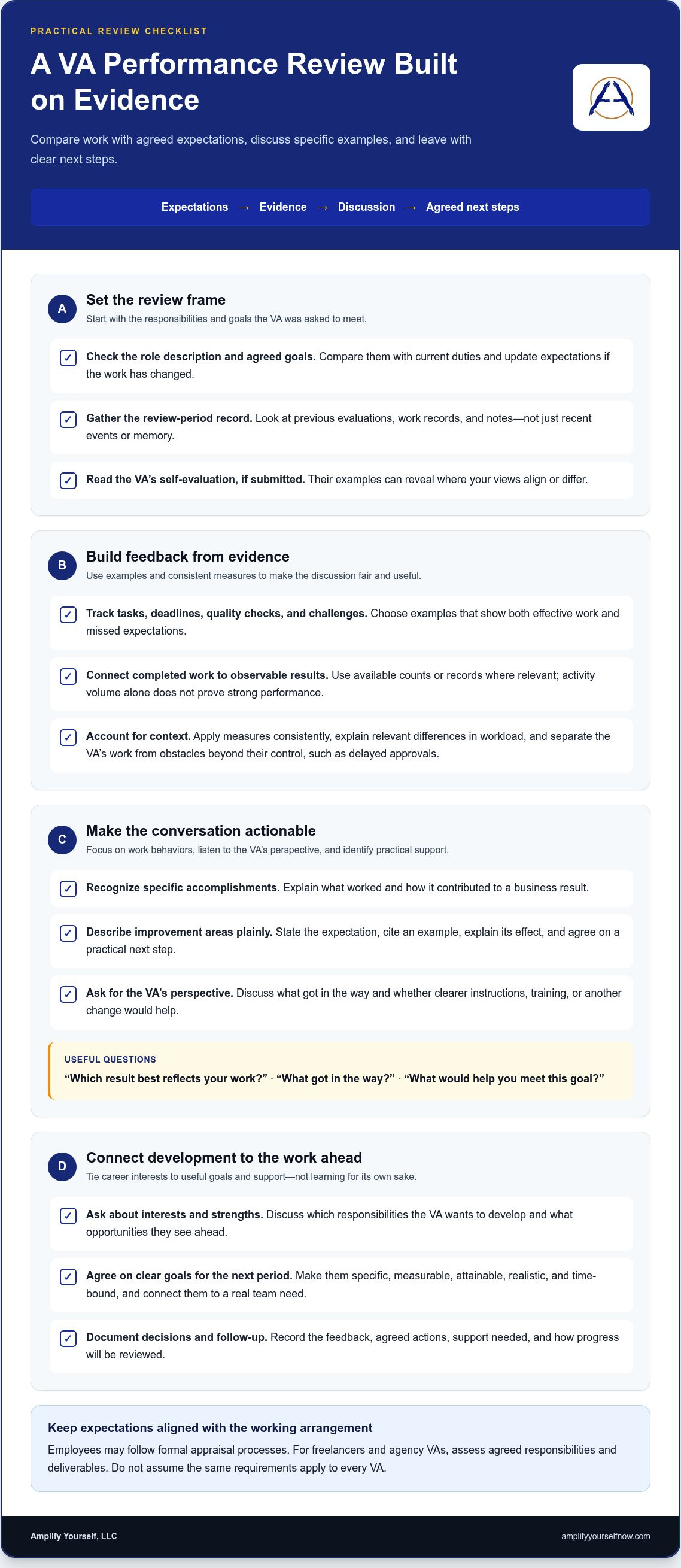
Compare the VA’s current duties with the job description and goals set earlier. Check the previous evaluation, work records, and notes from the review period. Virginia supervisors should consult the Employee Work Profile and relevant documentation. Update role expectations when duties have changed, so the evaluation reflects assigned work.
Review the VA’s self-evaluation before completing yours, if they submitted one. Their examples can show where you agree or see results differently. For employees covered by the Master Agreement, Article 27 says employees aren’t accountable for factors beyond their control. Separate an individual’s work from obstacles such as delayed approvals.
-
Assess Training Needs and Development Plans
Ask which tools, knowledge, or training would help the VA meet expectations. Individual Development Plans can help identify development and training needs related to career growth and work accomplishments. Set development plans at the start of the review period so they can guide the work ahead.
Connect each development need to the VA’s interests and a business outcome. For example, customer support training could help the VA handle requests more clearly. Agree on the support and a follow-up discussion instead of assigning learning without a clear work purpose.
- Freelance, agency, and employee VAs can all receive performance feedback, but the working arrangement affects how you set expectations. Employees may follow formal appraisal processes. For freelancers and agency VAs, assess agreed responsibilities and deliverables.
U.S. employment requirements depend on factors such as worker classification and applicable jurisdiction. Keep employee reviews job-related, consistent, and supported by records. Don’t assume that the same requirements apply to every VA.
- A complete review covers role expectations, accomplishments, strengths, improvement areas, the VA’s input, and goals for the next period. A practical way to conduct a performance review for a VA is to document these points and agree on useful next steps.
Reviews are often annual, though some organizations hold them more frequently. Choose a schedule that gives you and the VA regular opportunities to discuss progress and adjust expectations.
Using numbers and evidence to describe accomplishments
Build the discussion around records gathered throughout the review period. Specific examples connect completed work, obstacles, and goals without relying on general impressions.
-
Track Activities and Accomplishments
Keep a running record of completed tasks, deadlines, quality checks, and challenges. Compare your notes with the VA’s responsibilities and goals, then choose examples that show both effective work and missed expectations. Don’t rely on memory or count activity without considering whether it met the agreed standard.
Ask the VA which accomplishments they value most, what obstacles affected their work, and what support would help. Their answers can provide context that work records don’t show. For an annual review, use notes from the full period rather than focusing only on recent events.
-
Connect Accomplishments to Results and Impact
Link each example to an observable business result. For instance, explain how accurate customer follow-up helped resolve requests, or how organized order records made information easier to find. Use available counts, completion records, or quality checks where relevant, but don’t invent figures or treat volume alone as proof of strong performance.
Compare results with the expectations set for the role. Apply the same measures consistently and explain relevant differences in workload or circumstances. This helps the VA see how their work contributed and where results fell short of agreed goals.
- Give constructive feedback about actions, not personality. State the expectation, cite a specific example, explain its effect, and agree on a practical next step. If the VA missed expectations, describe the gap plainly, listen to their perspective, and discuss whether clearer instructions, training, or another change could help. Document the agreed action and how you’ll review progress.
Ask questions that lead to a useful discussion: “Which result best reflects your work?” “What got in the way?” “What would help you meet this goal?” Balance recognition with direct feedback, then connect each priority to an established goal. Keep the conversation focused on evidence and actions the VA can take next.
Connecting development needs to long-term career goals
Use the review to connect current expectations with the VA’s career interests. Agree on goals that support both their development and the work ahead.
-
Review the Job Description and Existing Goals
Compare the VA’s current responsibilities with their role description and previous goals. Note changed duties, completed objectives, and expectations that no longer fit. Ask which responsibilities they want to develop and what opportunities they see ahead. This grounds career planning in actual work rather than assumptions about what motivates them.
-
Draft Goals for the Next Review Period
Work with the VA to draft goals for the coming year and the next review period. Make each goal specific, measurable, attainable, realistic, and time-bound. For example, a VA interested in project coordination could take ownership of a defined workflow, with agreed measures for completion and quality. Connect the goal to a real team need, not development activity for its own sake.
- Build development plans around the skills needed to reach those goals. Choose a practical action, such as guided practice, mentoring, or a relevant class, and clarify what support you’ll provide. Ask which learning approach fits the VA’s career direction. A useful plan links a skill to a work task and explains how applying it could improve results.
- Close by recording each goal, its intended outcome, and the next check-in. Revisit progress during regular conversations instead of waiting for the next formal evaluation. If an open issue affects progress, assign a next action and agree when to discuss it. Adjust goals as responsibilities or business priorities change, while keeping the VA’s longer-term career aims in view.
Set goals and development plans together: align the VA’s career interests with role expectations, choose measurable work goals, and identify support and follow-up. This gives both of you a clear way to assess progress and adapt the plan as work evolves.
Briefings on performance review findings
Turn the evaluation into a clear briefing: what the VA did, what the evidence shows, and what happens next. Use concise language so the VA can understand each finding and respond.
- Open with the agreed expectations and the overall outcome. State which responsibilities or goals the briefing covers, then summarize the VA’s performance against them. According to MIT, review language should clearly describe accomplishments, strengths, development opportunities, and expectations for the coming year. Keep the summary balanced, so one recent success or setback doesn’t define the full review.
- Present each finding with an example and its practical impact. For instance, describe a missed handoff, the task it delayed, and the expected process. Then recognize a specific strength, such as accurate records that helped the team retrieve information. Focus on observable actions, not personality labels such as “careless” or “unmotivated.”
- Make improvement points actionable. Explain the expected behavior, the change needed, and how you’ll assess progress. Instead of saying “communicate better,” specify that the VA should flag a blocked task promptly and include the next step. Separate the performance issue from its cause, and invite the VA to share relevant context before agreeing on an action.
- Close the meeting by summarizing decisions, open questions, and follow-up actions. Record the feedback, agreed goals, support needed, and who owns each next step. Send the VA a written recap and ask them to confirm it’s accurate. Leave time for questions, since their response may clarify a finding or raise an issue the briefing missed.
A useful briefing leaves both people with the same understanding of the findings and next actions. If review conversations show that routine work is limiting your capacity, discuss which responsibilities you could delegate.
Keep feedback unbiased, clear, concise, and backed by specific examples. Document the feedback, goals, and action plans, then send a recap and ask the employee to confirm it’s accurate.
Amplify Yourself: Executive Virtual Assistant
Amplify Yourself, LLC connects business owners with virtual assistants whose responsibilities can be defined clearly and reviewed using evidence. If routine coordination is taking time away from higher-priority work, an Executive Virtual Assistant can support administrative and executive tasks. For customer inquiries or e-commerce operations, consider a Customer Support Representative or E-Commerce VA.
When you’re ready to delegate defined responsibilities and establish clear measures for the work, Amplify Yourself, LLC handles sourcing, screening, and onboarding. Schedule a free consultation to discuss your staffing needs.
Make the Next Review Easier to Act On
Knowing how to conduct a performance review for a VA gives you a repeatable way to guide performance, but the value comes from what changes afterward. Make agreed next steps part of your regular management routine. Keep goals visible, make space for questions, and address obstacles before they become recurring problems.
Use the next review to improve the working relationship, not just assess past work. Clear responsibilities and consistent feedback can help you delegate with greater confidence and protect time for decisions that need your attention. If you’re considering additional support for your operations, discuss your staffing needs with Amplify Yourself, LLC.
Start with one practical action from the review, then follow through. Consistent management builds clarity for you and your VA, one conversation at a time.
Frequently Asked Questions
What performance metrics should you use to evaluate a virtual assistant?
Choose measures that reflect the VA’s actual responsibilities, not generic activity counts. For calendar support, assess scheduling accuracy and whether changes reach the right people. For customer support, consider response quality and correct handling of issues. For bookkeeping, review record accuracy and completion of assigned tasks. Use information from the tools where the work happens, and don’t treat online availability as proof of performance.
How do you prepare for and conduct a VA performance review step by step?
Set up the review so both people understand its purpose, can prepare, and leave with recorded next actions.
- Schedule the conversation in advance and share the topics you’ll cover.
- Invite the VA to prepare a self-assessment and questions.
- Bring work records and a short agenda to the meeting.
- Discuss your findings, listen to the VA’s perspective, and clarify disagreements.
- Record decisions, send a recap, and set a follow-up conversation.

READY TO GIVE US A TRY?
Get Started for Free Today!
We'll connect you with top overseas talent for all your business endeavors.
Call 925-515-9343
Email: [email protected]


Privacy Policy | ©2026 Amplify Yourself, LLC. All Rights Reserved
Instagram
LinkedIn