
Transform your business
...with virtual assistants
Latest Blog Posts

Cost of Outsourced Bookkeeping 2026: The Strategic Guide to Scalable Leverage
Every hour you spend reconciling transactions is an hour stolen from your company's growth. In 2026, the real cost of bookkeeping isn't just the monthly invoice; it's the 10 to 20 hours a month business owners lose to manual data entry while US-based staff costs climb to $75 per hour. You know that clean, accurate financial data is the backbone of any elite operation, yet the burden of managing it often feels like a bottleneck rather than a tool for leverage. Understanding the cost of outsourced bookkeeping 2026 is no longer just a line item exercise. It's a strategic necessity to protect your margins as the Qualified Business Income deduction expires and top tax rates revert to 39.6 percent.
This guide from Amplify Yourself, LLC breaks down exactly how to amplify your efficiency by utilizing offshore talent to cut overhead by up to 70 percent. You'll discover the specific pricing models for 2026, from basic $300 monthly packages to full-service controller oversight. We will explore how to transition from a manual mess to a scalable system that provides the clarity you need to lead. If you're ready to stop playing defense with your books and start executing on your next breakthrough, it's time to build a financial engine that works as hard as you do. You can start that transition right now by scheduling a consultation at amplifyyourselfnow.com/appointment to see how these numbers apply to your specific model.
Key Takeaways
- Understand why professional delegation is a strategic necessity for entrepreneurs moving past the DIY bookkeeping bottleneck.
- Evaluate the cost of outsourced bookkeeping 2026 to find a pricing model that balances high-quality reporting with significant overhead reduction.
- Learn to calculate your Founder’s Hourly Rate to see the immediate ROI of reclaiming 10 to 20 hours of your time every month.
- Discover how a rigorous vetting process secures the top 1 percent of offshore financial talent to ensure your books remain audit-ready.
- Build a scalable system for financial clarity and start the process by scheduling an operational audit at amplifyyourselfnow.com/appointment.
The 2026 Bookkeeping Bottleneck: Why Outsourcing is a Strategic Necessity
In the 2026 digital economy, bookkeeping is no longer just about recording past transactions. It's a real-time data operation that fuels every strategic decision you make. For a high-performing founder, the transition from DIY record-keeping to professional delegation isn't just an administrative move. It's a clear signal that your business has moved from the survival phase into the scaling phase. You can't lead an elite organization if you're still buried in spreadsheets and manual reconciliations. These are low-leverage tasks that distract you from high-value execution and market expansion.
Cloud-based accounting tools have made the physical location of your finance team irrelevant. By integrating automated bank feeds and AI-driven categorization, remote teams can now provide a level of financial clarity that was previously reserved for large corporations. As you analyze the cost of outsourced bookkeeping 2026, you'll see that the investment is actually a play for speed and accuracy. It's about building a foundation that allows you to move faster than your competition.
To better understand how these pricing structures look in the current market, watch this helpful video:
The True Cost of Doing It Yourself
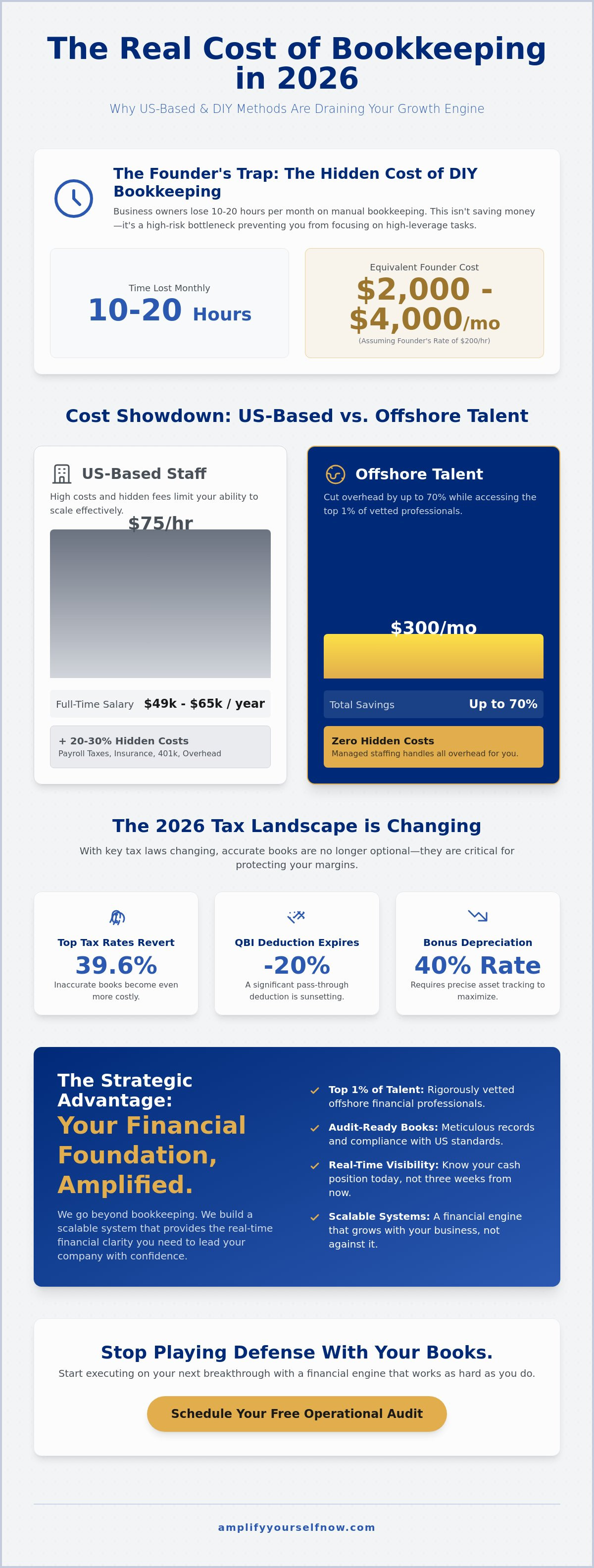
Data shows that business owners who manage their own books spend an average of 10 to 20 hours per month on these tasks. If your time is worth $200 an hour, you're essentially paying $4,000 a month for mediocre bookkeeping. This DIY approach carries a high risk of expensive mistakes. With the sunsetting of the Tax Cuts and Jobs Act in 2026, the top tax rate is reverting to 39.6 percent. Inaccurate books lead to poor tax planning and missed deductions, like the current 40 percent bonus depreciation rate. Staying small to save on admin costs is a trap that prevents you from ever reaching your full potential.
Market Trends Shaping 2026 Accounting
The market has shifted away from end-of-month reporting toward real-time financial visibility. You need to know your cash position today, not three weeks after the month ends. While AI integration has automated much of the data entry, elite founders know they still need a human expert to audit the machine and ensure compliance with standards like ASC 606 for revenue recognition. Remote-first staffing has leveled the playing field, allowing small businesses to access specialized talent that was once too expensive to hire domestically. If you're ready to stop managing data and start leading your business, you can explore a more efficient system at amplifyyourselfnow.com/appointment.
Breaking Down the Numbers: US-Based vs. Offshore Bookkeeping Costs
Choosing between a domestic hire and an offshore team is a decision that dictates your business's ability to scale. In 2026, the average cost of outsourced bookkeeping for US-based services ranges from $40 to $75 per hour. If you opt for a full-time in-house bookkeeper, you're looking at a base salary between $49,000 and $65,000. These figures only represent the starting point for domestic labor. When you calculate the total cost of outsourced bookkeeping 2026, you must look beyond the gross pay to understand the true impact on your margins.
Domestic employment carries heavy baggage that many founders overlook. You're responsible for payroll taxes, health insurance, 401k contributions, and the physical overhead of office space and equipment. These "hidden" costs typically add 20 to 30 percent on top of the base salary. For a growing startup, this lack of agility can be a fatal flaw. Managed staffing in the Philippines offers a different path, providing high-caliber talent that understands US GAAP and tax compliance without the domestic price tag.
The US Domestic Pricing Landscape
Local freelance bookkeepers in 2026 often charge between $45 and $95 per hour for specialized work. While they offer proximity, their rates are driven by their own high cost of living and business overhead. Many US accounting firms also require monthly minimums starting at $500 for even the simplest businesses, with full-service packages reaching $2,500. This pricing structure often forces entrepreneurs to choose between accurate data and sustainable cash flow. Domestic firms are frequently less agile, as their high internal costs prevent them from offering the flexible, scalable support that a fast-moving business requires.
The Offshore Talent Arbitrage
The Philippines has become the premier hub for elite financial talent due to its rigorous accounting education and cultural alignment with US business standards. Skilled Filipino bookkeepers expect a monthly salary between $1,200 and $2,500 for full-time equivalent roles. Hiring through a managed agency typically results in average monthly savings of 60 to 75 percent compared to domestic alternatives. Investing in a virtual bookkeeper allows you to access a dedicated professional for less than the cost of a part-time local assistant. This arbitrage isn't just about saving money; it's about reallocating those funds into growth-driving activities. If you're ready to see how this cost of outsourced bookkeeping 2026 fits into your current budget, you can request a custom cost-benefit analysis at amplifyyourselfnow.com/appointment.
Pricing Models and the Total Cost of Outsourcing
Finding the right financial partner requires looking beyond the sticker price. When evaluating the cost of outsourced bookkeeping 2026, you'll encounter several distinct pricing structures. Fixed monthly retainers are the standard for businesses seeking predictability. These typically range from $300 to $800 per month for simple operations, scaling up to $2,500 for full-service support including accounts payable and receivable. This model aligns interests. The provider is incentivized to be efficient, and you have a clear budget line item every month.
Hourly billing, while common among local freelancers, often creates misaligned incentives. When you pay by the hour, speed is penalized. US rates between $40 and $75 an hour can quickly balloon if reconciliations become complex or transaction volumes spike. For founders focused on leverage, the managed staffing model is usually the most effective choice. For a flat fee of $1,200 to $2,500 per month, you secure a dedicated offshore professional. This fee covers salary, benefits, and HR management, removing the administrative burden from your plate entirely.
There are many strategic reasons to outsource your bookkeeping, but the primary goal is always clarity. You must also account for one-time recruitment and onboarding fees. These are an investment in finding the top 1 percent of talent who can integrate into your specific workflow. Paying for a professional setup ensures that your charts of accounts are built for scale from day one.
Understanding Tiered Service Levels
Basic bookkeeping covers the essentials: bank reconciliations and monthly financial statements. This is the starting point for most small businesses. Full-charge bookkeeping goes deeper, managing your entire back office including payroll and bill pay. A helpful benchmark is the '1-4% Rule'. Most elite operators aim to keep their total accounting spend between 1 percent and 4 percent of their annual revenue. If you're spending more, your system is inefficient. If you're spending less, you're likely missing the data needed to scale properly.
Hidden Costs to Watch For
Your monthly service fee rarely covers everything. Software subscriptions for platforms like QuickBooks or Xero are typically separate costs that you must manage. You should also prepare for catch-up fees if your historical data is disorganized. These one-time costs can be significant but are necessary to establish a clean baseline. The most dangerous hidden cost is high turnover. Hiring cheap, unvetted freelancers often leads to errors that cost thousands to fix later. Investing in a vetted virtual bookkeeper through a managed system prevents these setbacks. If you're ready to move toward a predictable, high-performance financial system, you can explore your options at amplifyyourselfnow.com/appointment.
Calculating Your ROI: Beyond the Monthly Invoice
To calculate your true return on investment, you must first define your Founder’s Hourly Rate. If your business generates $500,000 in annual profit and you work 2,000 hours, your time is worth $250 per hour. Spending 15 hours a month on manual bookkeeping means you're effectively paying $3,750 for a task that should cost a fraction of that amount. When analyzing the cost of outsourced bookkeeping 2026, the primary goal is to stop this wealth leak. Elite founders don't look for the cheapest option; they look for the highest leverage.
Beyond time savings, accurate financial data is your best defense against the shifting tax landscape. With the top tax rate reverting to 39.6 percent in 2026 and the 20 percent QBI deduction expiring, proactive tax planning is no longer optional. Clean books allow your CPA to identify deductions and credits before the year ends, potentially saving you tens of thousands of dollars. This level of precision is impossible when you're rushing to catch up on reconciliations during tax season. Understanding the total cost of outsourced bookkeeping 2026 helps you identify the exact moment your business is ready for specialized support. You hit the break-even point for your first bookkeeper the moment their monthly fee is lower than the value of the hours they reclaim for you.
The Leverage Framework
Practical delegation starts with mapping your tasks. You should move everything in the 'Low Value/High Time' category to a specialized team immediately. Integrating a dedicated virtual assistant into your back office creates a 10x return by freeing you to focus on high-impact strategy and sales. This shift in mental bandwidth is where the real breakthrough happens. Real-time cash flow data allows you to pivot quickly; you can cut a failing product line or double down on a high-margin service based on facts rather than feelings.
Long-Term Scalability
A scalable financial department grows with your volume without doubling your overhead. By leveraging remote teams, you maintain a lean operation that maximizes your take-home profit. Professional, audit-ready books also significantly impact your business valuation. If you plan to exit in the next three to five years, having clean historical data can increase your sale price. Buyers pay a premium for clarity and reduced risk. Most acquirers will discount a business with messy books by 10 to 20 percent because of the perceived instability. You can start building this foundation today by taking the next logical step to schedule a strategic operations call.
Amplify Your Financial Foundation: The Managed Staffing Advantage
Amplify Yourself, LLC prioritizes the Philippines because it offers technical mastery and alignment with Western business standards. Unlike other regions, the educational system there is rooted in US GAAP standards, ensuring your financial data remains compliant without constant oversight. When you evaluate the cost of outsourced bookkeeping 2026, you're looking for a partner who understands your operational language. This allows you to integrate an offshore team into your existing US operations with minimal friction. You aren't just hiring a remote worker; you are installing a professional financial engine.
Most entrepreneurs struggle with delegation because they fear the time it takes to find the right person. We solve this through a rigorous 7-day vetting process designed to source the top 1 percent of financial talent. We don't just look for a resume; we look for a match. This includes technical proficiency testing in software like QuickBooks and Xero, as well as complex scenario testing for accounts payable and receivable. This speed to hire ensures your growth is never stalled by administrative gaps or hiring fatigue.
A successful partnership requires more than just a good hire. It requires ongoing performance monitoring and strategic support. We provide the infrastructure to ensure your bookkeeper stays productive and your data remains secure. This managed approach removes the risk of turnover and ensures your financial reporting remains a steady asset as you scale. You get the benefit of a dedicated professional without the burden of domestic HR management or the inconsistency of unvetted freelancers.
The Amplify Vetting Standard
Our standards go beyond basic data entry. Every candidate undergoes deep technical testing to ensure they can handle high-volume transactions and month-end closes with precision. We also emphasize culture-matching to ensure your assistant aligns with your long-term business vision. This ensures the person you hire isn't just a contractor, but a core part of your scaling engine. For a detailed breakdown of our protocols, you can review our Hiring Guide.
Your Next Step to Mastery
The goal is to stop managing spreadsheets and start managing your legacy. The Amplify onboarding process is built for speed, moving from an identified vacancy to a qualified hire in just one week. By locking in the cost of outsourced bookkeeping 2026 through a managed system, you protect your margins and reclaim the mental space needed for high-level execution. You've seen the numbers and the strategic logic; now it's time to act. You can take the first step toward a more efficient operation today. Schedule your strategic consultation now to find your dedicated bookkeeper and begin your breakthrough.
Build Your Scalable Back Office Now
Transitioning from a manual back office to a professional financial system is the hallmark of a business ready for its next breakthrough. By understanding the cost of outsourced bookkeeping 2026, you aren't just looking at a price tag; you're recognizing the value of reclaimed focus and strategic leverage. This guide has detailed how to move away from the DIY bottleneck and utilize specialized offshore teams to maintain lean, high-margin operations. Amplify Yourself, LLC provides the necessary infrastructure to make this transition seamless, ensuring your books are audit-ready while you prioritize high-impact execution.
The managed staffing model offers a level of security and performance that unvetted freelancers simply cannot match. With elite talent from the Philippines available in as little as 7 days, and ongoing HR and performance monitoring included, you can scale without the traditional administrative friction. It's time to stop managing spreadsheets and start leading your organization toward its highest potential. Schedule Your Strategy Call and Amplify Your Growth Now. Take the first step toward a steady, reliable financial foundation today.
Frequently Asked Questions
How much does outsourced bookkeeping cost for a small business in 2026?
Basic outsourced bookkeeping for simple businesses typically costs between $300 and $800 per month in 2026. For full-service support including accounts payable and receivable, prices range from $800 to $2,500. The cost of outsourced bookkeeping 2026 depends on your transaction volume and the complexity of your financial reporting needs. High-growth firms often pay more for controller-level oversight to ensure accuracy during scaling.
Is it cheaper to hire a bookkeeper in the Philippines than in the US?
Hiring a bookkeeper in the Philippines is significantly more cost-effective, with hourly rates between $10 and $25 compared to $40 to $75 in the US. The total cost of outsourced bookkeeping 2026 is often 60 percent to 80 percent lower when using offshore talent. This allows you to reallocate capital into marketing or product development while maintaining high standards of financial accuracy and GAAP compliance.
What is included in a monthly bookkeeping retainer?
A standard monthly retainer covers bank and credit card reconciliations, financial statement preparation, and general ledger maintenance. Comprehensive packages often include accounts payable, accounts receivable, and payroll processing. The scope usually depends on the number of accounts and transaction volume you manage. Clean, audit-ready books are the primary deliverable, providing the clarity you need to make informed strategic decisions for your business.
Can an offshore bookkeeper handle US tax compliance and payroll?
Yes, offshore bookkeepers trained in US GAAP can manage payroll and day-to-day tax compliance tasks. They use platforms like Gusto or ADP to process payroll and ensure withholdings are accurate. While they handle the data entry and filing preparation, it's a best practice to have a US-based CPA perform a final review of your annual tax returns to ensure total compliance with 2026 regulations.
What is the difference between a bookkeeper and a CPA?
A bookkeeper manages your daily financial transactions, bank reconciliations, and monthly reports. A CPA focuses on high-level tax strategy, auditing, and filing official government documents. You need a bookkeeper to maintain clean data so your CPA can work efficiently. This division of labor ensures you aren't paying a CPA's higher hourly rate for routine data entry tasks that don't require their specialized certification.
How do I ensure my financial data is secure with a virtual assistant?
Security is maintained through restricted software access and encrypted password management tools like LastPass or 1Password. You should never share primary login credentials; instead, provide your bookkeeper with "Standard User" access in QuickBooks or Xero. Using a VPN and ensuring your assistant works on a secure, private network adds another layer of protection. Managed agencies also conduct background checks to verify the integrity of their staff.
What software should my outsourced bookkeeper use?
Most outsourced professionals use cloud-based platforms like QuickBooks Online or Xero for real-time accessibility. You should also integrate receipt management tools such as Dext or Hubdoc to automate data extraction. These tools allow your bookkeeper to work seamlessly from any location while providing you with an instant view of your cash flow. Cloud software is essential for the collaborative, remote-first environment of 2026.
How much should I spend on bookkeeping as a percentage of my revenue?
Elite operators typically aim to keep their total accounting and bookkeeping spend between 1 percent and 4 percent of annual revenue. If your revenue is $1 million, your annual spend should stay between $10,000 and $40,000. Staying within this range ensures you have the financial clarity needed for growth without overextending your overhead. This benchmark helps you measure the efficiency of your current financial department and identify when it's time to scale your team.

READY TO GIVE US A TRY?
Get Started for Free Today!
We'll connect you with top overseas talent for all your business endeavors.
Call 925-515-9343
Email: [email protected]


Privacy Policy | ©2025 Amplify Yourself, LLC. All Rights Reserved
Instagram
LinkedIn