
Transform your business
...with virtual assistants
Latest Blog Posts

AI Assistant vs. Virtual Assistant: The 2026 Executive Guide to Strategic Leverage
Adding more software to your business often increases your workload instead of reducing it. For many entrepreneurs, the distinction between an ai assistant vs virtual assistant is unclear, leading to a fragmented strategy that relies too heavily on automation. While software is efficient for data processing, it lacks the contextual awareness required for high-level operations. Without a clear framework, you may find yourself spending more time managing your tools than leading your team.
Managing a complex tech stack can quickly become a full-time job in itself. We agree that your primary goal is to build a scalable operation that functions reliably without your constant oversight. This guide will clarify the functional differences between software-driven tools and human professionals so you can implement a delegation strategy that works. We will analyze the ROI of both options, identify which tasks belong to which resource, and provide a framework for creating a high-performance system that is built for long-term stability.
Key Takeaways
- Understand the fundamental difference between an ai assistant vs virtual assistant to ensure you are utilizing the right tool for the right level of complexity.
- Identify the "Judgment Gap" where software-based automation fails to capture the cultural context and strategic nuances of your business.
- Implement the 70/30 delegation rule to automate data processing while keeping high-impact decision making in human hands.
- Calculate the true ROI of integrating vetted human talent as the strategic manager of your technology stack for long-term scalability.
- Build a future-proof operation by prioritizing human partnerships that support your vision and prevent the isolation of leading a purely automated team.
Defining the 2026 Landscape: AI Assistant vs. Virtual Assistant
The current business landscape requires a clear understanding of how different resources contribute to your operations. When comparing an ai assistant vs virtual assistant, the most important factor to consider is the level of judgment required for the work. Software is designed to follow rules and process information at scale, while human professionals are equipped to understand goals and adapt to changing circumstances. If you rely solely on automation, you may find that your business lacks the adaptability needed to handle complex projects.
Effective delegation involves placing these resources in a hierarchy that supports your growth. The core distinction comes down to rules versus agency. Software follows a set of predefined instructions to predict an outcome. Agency, however, is the ability to understand a broader objective and pivot when the environment changes. To better understand how these functions differ in practice, watch this overview of AI capabilities:
The AI Assistant (Software) Defined
An AI assistant is a software program that uses natural language processing to generate text, summarize data, or draft simple communications. These tools are excellent for low-context tasks where speed is the priority. For example, they can summarize a transcript or draft a basic email template in seconds. However, they operate within the limits of their training data and cannot account for the subtle nuances of your specific business environment. They are reactive tools that require specific instructions to produce useful results, and they lack the ethical judgment required for high-stakes decisions.
The Virtual Assistant (Human) Defined
To understand what is a virtual assistant in a professional context, you must look at the human professional who manages complex workflows. An Executive Virtual Assistant acts as a strategic partner who exercises critical thinking and emotional intelligence. Unlike software, a human assistant can manage cultural nuances and maintain brand consistency through real-world judgment. They serve as the essential human-in-the-loop, ensuring that your automated systems remain accurate and aligned with your long-term objectives. They don't just follow prompts; they manage outcomes.
Navigating the ai assistant vs virtual assistant landscape leads many successful owners to a model of "Hybrid Leverage." In this setup, your human assistant manages your AI tools. This ensures that your business benefits from the speed of automation without sacrificing the quality or reliability of your operations. By combining the processing power of software with the agency of a professional, you create a system that is both scalable and strategically sound.
The Judgment Gap: Where AI Ends and Human Intelligence Begins
Software is designed to follow instructions, but it lacks the ability to understand the broader implications of its actions. When evaluating the ai assistant vs virtual assistant dynamic, the most significant difference is the capacity for judgment. While an AI can process data based on historical patterns, it does not have a personal investment in the success of your business. If you want to scale your operations, you need a resource that can distinguish between a completed task and a successful business outcome.
Strategic thinking remains a human-led activity. An AI can draft a single social media post or an email, but it cannot plan a multi-channel product launch that requires coordination across different departments. This is the difference between executing a task and managing a project. Tasks are repeatable and can be automated; projects are strategic and require an understanding of how multiple variables fit together. Relying on software for high-level planning often results in a generic strategy that lacks the specific direction needed to grow a business.
Context vs. Calculation
AI operates in a strictly rule-based environment, calculating probabilities based on information it has already seen. It cannot interpret a subtle shift in a client’s tone or recognize the unspoken rules of your business culture. A human assistant, however, can sense when a standard response might alienate a long-term partner. Judgment is the ultimate executive commodity in 2026. While software provides the raw data, only a human can provide the nuance required to navigate complex professional relationships.
Effective relationship management requires empathy and the ability to pivot in real-time. Whether it is handling Customer Support or communicating with stakeholders, a script cannot replace the intuition of an experienced operator. A human virtual assistant knows when a situation requires a personalized approach rather than a standard operating procedure. They manage the human connections that build your brand equity, while the AI handles the background data processing.
Accountability and Ownership
One of the most practical reasons to hire a professional is accountability. You cannot hold an algorithm responsible for a missed deadline or a brand inconsistency. If an AI tool produces an error, the burden of fixing it falls back on the entrepreneur. A virtual assistant takes ownership of the outcome. They act as a reliable filter, ensuring that every piece of content or data is accurate and aligned with your standards before it reaches your desk. Delegation requires a feedback loop that software cannot yet replicate.
If you are looking for a way to improve your operational efficiency without increasing your personal workload, it may be time to transition from managing tools to leading a team. You can schedule a strategy session to discuss how a human-led operation can provide the leverage your business needs to scale effectively.
AI Assistant vs. Human VA: A Comparative Framework for ROI
Don't get blinded by the twenty dollar monthly subscription. It's a common trap for founders looking for a shortcut to scale. The real math of the ai assistant vs virtual assistant debate isn't about the price of the license; it's about the cost of your attention. If you're the one spending your morning "prompt engineering" or fixing a hallucinated fact in a draft, you haven't found leverage. You've just traded one form of manual labor for another. True ROI is measured by how much you can remove yourself from the process, not how many tools you can add to it.
Every minute you spend troubleshooting a software tool is a minute you aren't leading your company. This is the "Management Tax." It's the hidden friction that makes software-only solutions feel like a bargain but act like a burden. While AI can generate content in seconds, "instant" is often a myth. If a bot creates a report in three seconds but you spend thirty minutes verifying the data and correcting the tone, you've actually lost ground. A human assistant manages this entire loop, delivering a finished product that is ready for your signature, not your revisions.
Task-Level vs. Role-Level Support
AI tools handle tasks; dedicated professionals handle roles. When you pay Managed Staffing Fees, you aren't just buying hours. You're buying a piece of your business infrastructure. A task is a single event, like drafting an email. A role is a set of responsibilities, like managing your entire inbox and ensuring no high-value lead goes unanswered. One is a cost; the other is an investment. If you want to understand the true cost-benefit of this shift, our Hiring Guide provides the templates you need to evaluate your current staffing needs accurately.
Long-term Value and Institutional Knowledge
Software has no memory of your "why." The moment you clear a chat thread or start a new project, the context is often lost. A human assistant grows with your company. They learn your quirks, your preferences, and your vision. They become a repository of institutional knowledge that software cannot replicate. They remember why you fired a specific vendor three years ago and why you prefer a specific tone with certain stakeholders.
This deep context is what allows a business to scale without the founder's constant intervention. High-level talent from the Philippines provides this strategic partnership at a sustainable price point. They don't just use your systems; they build them. They document the workflows that your AI tools will eventually run, creating a scalable operation that increases in value every single day. You aren't just comparing an ai assistant vs virtual assistant; you're deciding whether you want a tool or a team. One helps you work; the other helps you win.
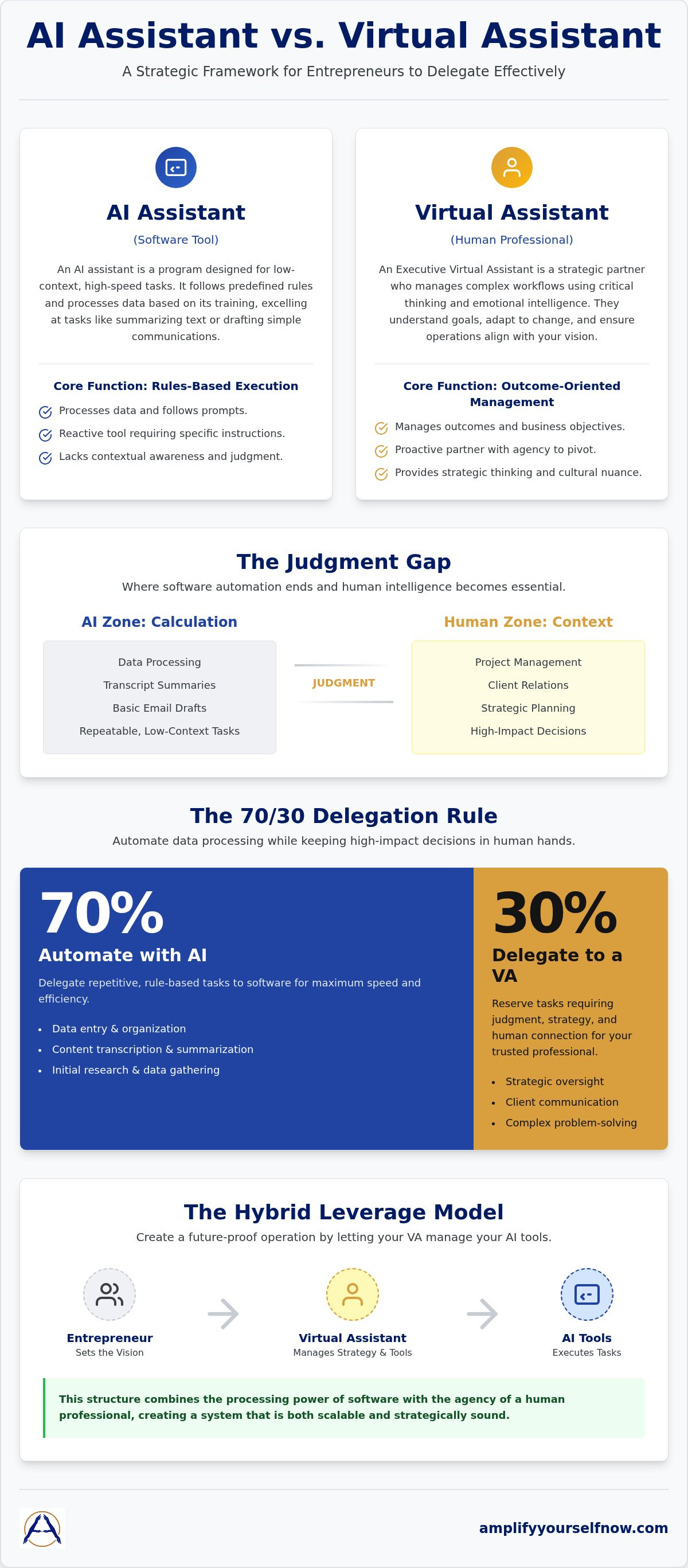
Strategic Delegation: When to Use AI and When to Hire a VA
The most effective founders operate on a 70/30 rule of delegation. Seventy percent of your business likely consists of data processing, information retrieval, and repetitive workflows. This is where software excels. The remaining thirty percent involves high-stakes decisions, relationship management, and strategic pivots. This is where human judgment is non-negotiable. When evaluating the ai assistant vs virtual assistant dynamic, you aren't looking for one tool to do everything. You're building a hierarchy where software handles the volume and a human manages the value.
Distinguishing between high-impact and high-volume tasks is the key to scaling without burnout. High-volume tasks are predictable and frequent. High-impact tasks require context and can change the trajectory of your quarter. If you're spending your own time prompting an AI to get a task "just right," you've fallen into the DIY trap. You've simply replaced one manual task with another. Instead, a professional should be managing that tech stack for you.
The AI Task List (High Volume, Low Context)
Use AI for the heavy lifting of raw data. It's perfect for initial research phases, drafting basic email templates, or summarizing long internal meetings. It can handle massive amounts of Data Entry Support without fatigue. These are tasks where the cost of a mistake is low and the speed of execution is the priority. AI is your engine; it isn't your driver. It processes the information so your team can act on it.
The VA Task List (High Context, High Judgment)
Your human assistant handles the workflows that require a pulse. This includes complex calendar management where gatekeeping is essential to protect your focus. They manage strategic Lead Generation campaigns, vetting potential partners before they ever reach your inbox. They also handle sensitive Bookkeeping and financial workflows where accuracy and confidentiality are paramount. These roles require the ability to understand "why" a task matters, not just "how" to do it.
Your first strategic hire should be an Executive Virtual Assistant who can act as the manager of your entire tech stack. They ensure your AI tools are actually producing ROI instead of just creating more work for you. By delegating the management of the software to a human partner, you finally achieve true leverage. You stop being the operator and start being the owner. You move from the weeds of execution to the clarity of leadership.
Ready to build your high-performance team? Schedule your strategy call to find the right partner for your business.
Beyond the Bot: Why High-Growth Founders Prioritize Human Partnership
Scaling a company is a psychological marathon. You've likely felt the weight of "AI loneliness" recently; it's that distinct realization that while your tools are faster, you're still the only one carrying the responsibility for the results. In the high stakes world of 2026, the ai assistant vs virtual assistant debate is resolved by the need for partnership. You can't lead a team of robots to a visionary goal. Legacy isn't built on processed data. It's built on shared conviction, strategic pivots, and human grit. You need a human partner who sees your vision and fights for it as hard as you do.
Software doesn't celebrate your wins. It doesn't lose sleep over your losses. When you choose a human assistant, you're choosing a co-pilot who understands the stakes of your mission. This is the difference between having a tool and having a team. Top tier achievers know that true leverage comes from people who can think, adapt, and lead. You aren't just looking for an ai assistant vs virtual assistant comparison; you're looking for the catalyst that will propel your business to its highest potential.
The Future of Work is Collaborative, Not Automated
The most successful founders don't replace humans with software. They empower humans with software. A vetted Virtual Assistant Philippines uses AI to amplify their own output, effectively becoming a "Super-Assistant" for your brand. They provide the judgment while the software provides the speed. This creates a competitive advantage that a bot-only operation simply can't match. You get a reliable, high-level professional who acts as your strategic advisor, ensuring your systems are both efficient and human-centric.
Taking Action: Your Scaling Roadmap
You must decide today to stop being the bottleneck in your own expansion. Start by auditing your workload for the next seven days. Identify every task that drains your energy. List every decision that doesn't require your specific genius. The mission at Amplify Yourself, LLC is to connect visionaries with the human talent that makes growth inevitable. We manage the vetting and onboarding so you can have a high-level professional integrated into your business in as little as seven days. This is the fastest path to reclaiming your status as a visionary leader.
The time for transformation is immediately present. Don't let your business plateau because you're too busy managing tools. Reclaim your time. Expand your reach. Build your legacy. Immediately schedule your strategy call to amplify your business. The path to a scalable, high-performance operation starts with a single decision to lead.
Master Your Strategic Leverage
Reclaiming your focus is the final stage of the 2026 growth roadmap. You now understand that the choice between an ai assistant vs virtual assistant isn't about cost; it's about the speed of your expansion. Software handles the processing while your human partner handles the progress. This structural alignment ensures your business remains agile and responsive without requiring your constant intervention.
Amplify Yourself, LLC delivers vetted talent from the Philippines in as little as seven days; providing the specialized support you need for Marketing, Lead Gen, and Executive workflows. Our managed staffing model includes ongoing performance monitoring and HR support so you can lead with absolute confidence. Stop managing tools and start leading your legacy.
Scale your business today—Book your VA strategy call.
The path to a high-performance operation is clear; it's time to take the next step.
Frequently Asked Questions
Is an AI assistant better than a virtual assistant for a small business owner?
No, they serve different operational purposes. An AI assistant is a tool for processing data and drafting content quickly. A virtual assistant is a professional partner who manages your workflows and makes decisions based on your business goals. For a small business owner looking to scale, a human partner provides the judgment and execution that software cannot replicate.
What are the biggest risks of relying solely on an AI assistant for executive tasks?
The biggest risks are a lack of accountability and the absence of contextual judgment. AI tools can hallucinate facts or fail to understand the nuance of a sensitive client relationship. If a mistake is made, you cannot hold software responsible for the fallout. Relying solely on automation often creates a "management tax" where you spend more time checking the tool's work than you would have spent delegating it to a professional.
Can a virtual assistant manage my AI tools for me?
Yes, and this is the most effective way to build a high-performance operation. A high-level virtual assistant acts as the manager of your tech stack. They use AI to speed up data processing and content drafting while providing the final human-in-the-loop verification. This ensures that your outputs are accurate and on-brand without requiring your personal intervention in the software.
How much does a virtual assistant cost compared to a suite of AI tools?
A suite of AI tools typically costs a fraction of a professional's salary, but the comparison of ai assistant vs virtual assistant costs should focus on ROI. Software is a line-item expense for specific tasks. A human assistant is an investment in business infrastructure. While you pay more for a dedicated professional, the value of reclaimed executive time and the ability to delegate entire roles far outweighs the cost of tool subscriptions.
What tasks should I never delegate to an AI assistant?
You should never delegate high-stakes negotiations, sensitive personnel issues, or final strategic approvals to an AI. These tasks require emotional intelligence and an understanding of long-term consequences that algorithms lack. While AI can help prepare data for these conversations, the actual execution and relationship management require a human touch to maintain trust and professional standards.
Is it better to hire a virtual assistant from the Philippines or use a US-based AI tool?
It's better to use both strategically rather than choosing one. A US-based AI tool is excellent for rapid data analysis or drafting. However, a virtual assistant from the Philippines provides the operational support and continuity needed to run a business. Vetted talent from the Philippines offers high-level executive support at a sustainable price point, allowing you to build a reliable team that grows with your company.
How long does it take to see an ROI when hiring a human virtual assistant?
Most founders see a significant return on their time within the first 30 days of onboarding. Through Amplify Yourself, you can have a vetted professional integrated into your workflows in as little as seven days. The ROI manifests as a reduced workload and the ability to focus on high-impact revenue-generating activities that were previously neglected due to administrative burnout.
Can an AI assistant replace a human bookkeeper or customer service rep?
AI cannot fully replace a human bookkeeper or customer service representative because these roles require accountability and nuance. An AI can categorize transactions or answer basic FAQs, but it cannot resolve a complex billing dispute or empathize with a frustrated client. In the ai assistant vs virtual assistant landscape, the human professional uses the AI to work faster while maintaining the quality and trust your brand requires.

READY TO GIVE US A TRY?
Get Started for Free Today!
We'll connect you with top overseas talent for all your business endeavors.
Call 925-515-9343
Email: [email protected]


Privacy Policy | ©2025 Amplify Yourself, LLC. All Rights Reserved
Instagram
LinkedIn